Something has changed in the way brands approach custom packaging.
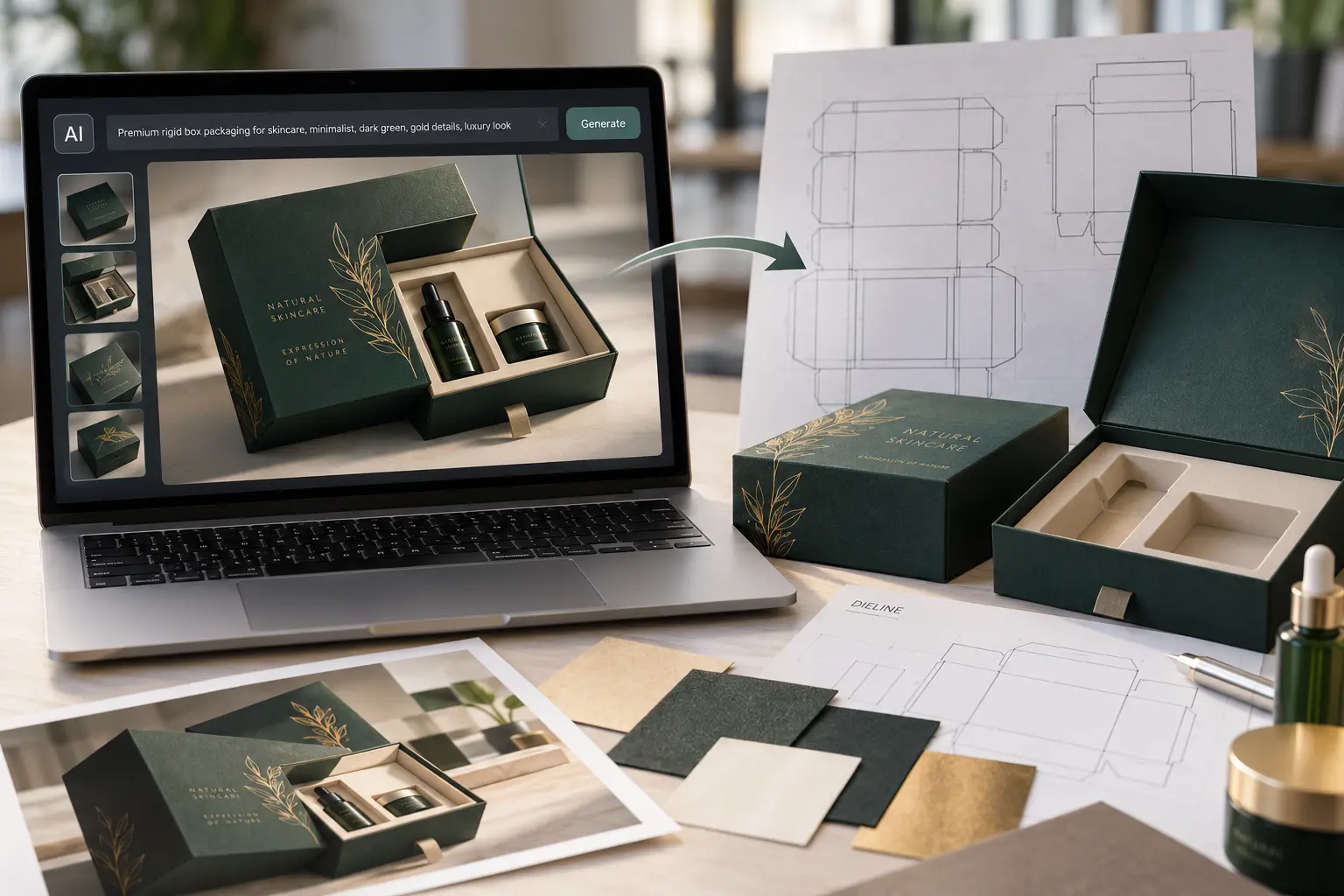
Over the past year, we have noticed a very clear shift in the type of material clients send us when they first contact DST-Pack. Instead of starting with a technical drawing or a professionally prepared packaging design, many inquiries now arrive with a concept image generated with AI. In fact, almost two-thirds of the packaging inquiries we currently receive include some form of AI-generated visual reference.
For us as a packaging manufacturer, this is an interesting development because these images are neither completely useless nor production-ready. They sit somewhere in between. They are often technically inaccurate, sometimes geometrically impossible to reproduce exactly, and almost never suitable to be used directly as final artwork. At the same time, they can be an extremely effective way for a client to communicate an idea that would otherwise be difficult to describe.
That distinction is important because there is a big difference between showing a manufacturer what you want your packaging to look like and giving a manufacturer the files needed to produce it.
An AI-generated image can do the first part surprisingly well.
It usually cannot do the second.
The image helps us understand the idea
When a client sends us an AI-generated packaging concept, we don’t look at it as if it were a production drawing. We look at it as a visual explanation of the client’s intention.
A written inquiry might tell us that the client wants a premium rigid box with a magnetic closure, a dark green finish, gold details and a custom insert for a cosmetic product. That gives us useful information, but an image can communicate the overall direction much faster. We can immediately see the approximate proportions, the way the box is supposed to open, the visual relationship between the product and the insert, the intended colours and the general feeling the client wants the packaging to create.
This can be particularly helpful when the client is not a packaging designer and doesn’t necessarily know the technical terminology used in the industry. They may not know whether the construction they are imagining should be made as a rigid setup box, a magnetic box, a drawer box or another structure. They may also not know what type of insert would be appropriate or which finishing process would create the effect they have in mind.
They don’t necessarily need to know all of that at the beginning.
They can show us the image and explain what they like about it.
From there, the conversation becomes much easier because we have something visual to work from.
The problem starts when the concept is treated as artwork
The fact that an AI image can look extremely realistic sometimes creates the wrong expectation.
Modern image generators can produce packaging concepts that look like professional product photography. The box can appear perfectly constructed, the logo can look correctly positioned, the insert can appear to fit the product precisely and the finishing effects can look completely convincing.
But the image was created to look correct from a particular visual perspective.
It was not created to describe how the package should actually be manufactured.
That difference becomes obvious as soon as we try to move the concept into production.
A physical package has geometry. It has panels, folds, cuts, glue areas, tolerances and material thicknesses. The different parts need to work together when the package is assembled, and the artwork needs to follow the actual construction of the box.
An AI-generated image does not contain that information in a usable production format.
It can show us the outside of a box, but it does not give us the actual dieline required to manufacture it. Even when the geometry looks perfectly logical in the image, the underlying construction may not make sense once it is unfolded into a flat production layout.
This is particularly noticeable with more complicated structures. A lid may appear to fit perfectly onto a base even though the dimensions would not work in reality. An insert may look as if it holds a product perfectly while giving no indication of how it should be manufactured. A flap may disappear behind another part of the box, or a decorative element may cross a fold without taking the actual construction into account.
The image can still be useful.
It simply needs to be treated as a concept rather than as a technical file.
Why we cannot simply put the AI image onto a dieline
This is probably the part that causes the most confusion.
A client may have an AI-generated image that already contains the logo, colours, graphics and decorative elements and reasonably assume that the manufacturer can simply extract those elements and place them onto the dieline.
In practice, it rarely works that way.
The artwork for a physical package has to be prepared according to the actual construction. Once the dieline has been developed, the different graphic elements need to be positioned across the correct panels, with the necessary bleed, safe areas and allowances for cuts and folds.
Finishing processes introduce additional technical requirements. Foil stamping, embossing, debossing, spot UV and other effects may require separate layers or clearly defined production areas. None of that information is reliably contained inside a generated image.
There is also the problem of the graphics themselves. AI-generated text can be distorted or inconsistent, logos can be slightly changed, small details can merge together and patterns that look convincing in the image may not exist as usable vector artwork.
So even if the client has created a beautiful packaging concept, the next step is normally to recreate or develop the actual artwork properly.
The AI image becomes the visual reference.
The production artwork becomes a separate piece of work.
This does not mean AI concepts are a problem
Actually, we quite like receiving them.
The important thing is simply that everyone understands what the image is being used for.
A concept image can save a lot of back-and-forth at the beginning of a project because it gives the packaging manufacturer a much clearer idea of what the client has in mind. Instead of trying to interpret a vague description such as “something premium and minimal with a luxury feel,” we can look at the reference and discuss the specific elements that make the concept attractive to the client.
Perhaps it is the deep colour of the box.
Perhaps it is the way the lid opens.
Perhaps it is the contrast between the exterior and the insert.
Perhaps it is the combination of a textured paper with a metallic detail.
Perhaps the client simply likes the overall proportions and presentation.
Those details give us something concrete to discuss.
They also allow us to identify very early which parts of the concept are straightforward to manufacture and which parts will need to be adapted.
That is often much more useful than trying to reproduce an image exactly.
The final packaging may look different from the AI concept
This is something brands should expect.
When a concept moves from an image into real packaging, certain elements may need to change.
The proportions might be adjusted because of the actual product dimensions. An insert might need a different construction because the product needs additional protection. A decorative element may need to move because it crosses a fold or cutting line. A particular visual effect may be achieved using a different finishing technique because the original effect shown in the AI image is not technically practical.
That does not necessarily mean the concept has been lost.
In many cases, the objective is not to reproduce the image pixel by pixel. The objective is to preserve the idea behind it while adapting the construction so that the result can actually be produced, assembled, transported and used.
This is where the experience of a packaging manufacturer becomes important.
A manufacturer should not simply say, “This is what the image shows, so this is what we have to make.”
Sometimes the better answer is to explain that a slightly different construction will achieve almost the same visual result while being more reliable or more economical to manufacture.
The image starts the conversation.
It does not have to dictate every technical decision that follows.
AI has made the first packaging conversation easier
One of the more interesting changes we have noticed is that clients are now able to arrive with a much more developed visual idea even when they don’t have a designer or technical packaging background.
Previously, a company might have had an idea in their head but struggled to explain it to a manufacturer. They could send a few reference photographs and write a description, but there was often a gap between what they imagined and what the manufacturer understood.
AI has made it much easier to close that gap.
A brand can generate several different versions of a packaging concept, decide which direction feels closest to the product and then send that image to the manufacturer as a starting point.
From there, the normal packaging development process can begin.
The dimensions need to be confirmed.
The construction needs to be selected.
The material needs to be specified.
The insert needs to be developed.
The artwork needs to be prepared.
A dieline needs to be created.
A sample needs to be produced and checked.
Only after those steps does the concept become an actual manufactured package.
The important distinction is simple
We increasingly receive AI-generated packaging concepts, and we expect that number to continue growing.
For a packaging manufacturer, there is no reason to reject them simply because they are not technically accurate.
They are useful because they help us understand what the client is trying to achieve.
What we would not recommend is treating the generated image as the final artwork or assuming that it can simply be extracted and placed onto a production dieline.
It usually cannot.
The geometry needs to be developed properly, the graphics need to be prepared for the actual packaging structure and the technical requirements of printing and finishing need to be taken into account.
So if your packaging concept currently exists as an AI-generated image, that is perfectly fine.
Send it to the manufacturer.
Use it to communicate the vision.
Just understand that there is still another step between “this is what I want it to look like” and “this is the file we can manufacture.”
At DST-Pack, we see that transition happening more and more often.
And in our experience, an AI-generated image can be a very good place to start — as long as everyone understands that it is a starting point, not the finished packaging artwork.