Send a box design to five factories and you might get back three quotes, one “we can’t produce this,” and one that never replies. If that’s happened to you, you’ve run into something most first-time buyers don’t expect: not every packaging factory makes the same kind of box, and several of them are physically unable to make the kind you’re asking for.
Two Different Businesses, Wearing the Same Label
“Packaging factory” covers two distinct kinds of operations, and the difference matters more than most buyers realize before they’ve been burned by it once.
The first is a machine-line factory. These run large corrugators, folding-carton lines, and die-cutters that take a flat sheet, score it, cut it, and fold it into a finished box in a single automated pass. It’s an efficient model — once a die is made, the line can turn out tens of thousands of identical folding cartons a day at a cost per unit that a hand-finished box could never touch. The catch is that the design has to fit what the machine can do: a shape the folding sequence supports, a material within the line’s thickness range, printing that fits the press. Ask for anything outside that envelope and you’ll get either a redesign suggestion or a flat no.
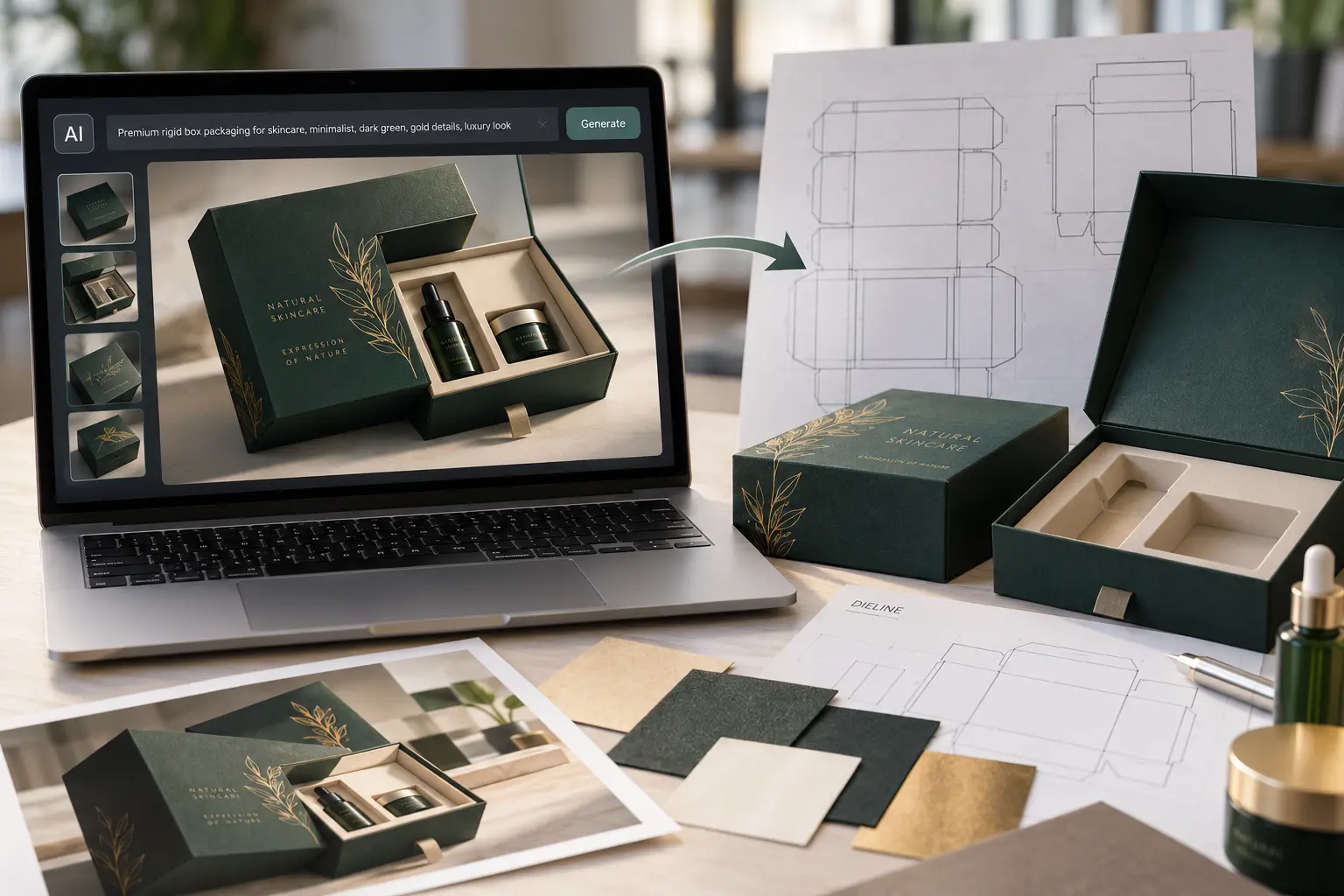
The second is what we’d call a construction-and-finishing operation — the category we work in. This is where rigid boxes, magnetic-closure lids, drawer-style boxes, and multi-piece assemblies get built. A rigid box isn’t cut and folded from one sheet; it’s built up from a chipboard core, wrapped in printed paper or fabric, with corners mitered or turned by hand or semi-automated equipment, then assembled into its final structure — lid, base, magnet, ribbon pull, whatever the design calls for. Machines do plenty of the work here too, but the process leans on manual judgment at several steps in a way a folding-carton line never has to.
What “Complex Construction” Actually Involves
It’s worth being specific about what separates these builds from a printed carton, because the difference isn’t cosmetic — it’s structural, and it shows up at nearly every stage of production.
Take a rigid box with a magnetic closure. The chipboard core has to be cut to precise internal dimensions first, since any variance compounds once the wrap goes on. The wrap itself — paper, fabric, or a specialty substrate — is applied with wet or hot-melt adhesive, and a clean, bubble-free finish around corners is still a skill automated equipment can’t fully replace, especially on textured or fabric-wrapped surfaces. The magnet has to sit flush and aligned so the lid closes properly every time, not just on the sample unit. If the design calls for an interior insert, a ribbon pull, or a printed liner, each gets added as its own step, with its own tolerance for error.
A drawer-style box raises the difficulty further: the sleeve and the drawer must be built to complementary tolerances, tight enough that the drawer doesn’t fall open in transit but loose enough to slide smoothly. A book-style box with a magnetic spine has to open and close cleanly hundreds of times without the hinge failing. None of this is exotic — it’s standard practice for anyone who builds rigid packaging regularly — but it’s also a set of skills a folding-carton line has no reason to develop, since nothing in its normal workflow calls for it.
Why a Machine-Line Factory Turns Your Order Down
This isn’t a factory being unhelpful. A folding-carton line is built around consistency: same material, same thickness, same fold pattern, run after run. Retooling it for a one-off rigid construction with a magnetic closure is no small ask — in many cases the equipment to wrap and assemble rigid board isn’t even on the floor, because it belongs to a different category of machinery serving a different part of the market.
There’s a margin logic behind it too. A machine-line factory makes its money on volume and repeatability. A design that needs hand-finishing introduces labor cost and quality-control variability that doesn’t fit that model — even a factory that owns a wrapping machine rarely has reason to prioritize a complex, lower-volume custom job over a large standing folding-carton order. So the honest answer is usually “not for us,” even when the design itself is entirely reasonable.
The Cost of Not Knowing the Difference
The buyers who run into the most friction are the ones who don’t discover this until they’re weeks into sourcing. A design goes out to five factories found through a general directory or marketplace search. Three come back with a simplified version, without mentioning they’ve changed anything structural. One quotes the design as sent, at a price that looks oddly high next to the others — until it’s clear the other three were never quoting the same box. One never responds, because the request landed with someone who had no reason to reply to work outside their capability.
That mismatch costs time, and sometimes more than time. A brand that approves a “quote” without realizing the factory has quietly swapped a magnetic closure for a tuck-in flap, or a rigid construction for a heavier folding carton, can end up with sample boxes that don’t match what they designed — often discovered only after a deposit is paid and a production slot is booked.
Where This Leaves a Buyer
A lot of people end up stuck between two bad options: simplify the design to fit what a machine-line factory can run, or find a factory that actually does construction-and-finishing work — a smaller, less commoditized corner of the market that’s harder to spot from a generic directory listing or marketplace search.
We specialize in the second category. Rigid boxes with magnetic closures, drawer constructions, book-style openings, foil stamping, embossing, soft-touch and matte finishes — these builds combine machine work with hands-on assembly and finishing, and they’re the core of what we do rather than a side offering bolted onto a folding-carton business. That’s also why we’re set up for brands designing something more structurally ambitious than a printed carton, rather than steering every request toward whatever a machine line could produce.
How to Tell Which Kind of Factory You Need
A few questions tend to sort this out quickly, and they’re worth asking before you send a full design package to anyone:
- Does the design need a rigid, chipboard-core structure, or would a printed and die-cut folding carton do the job? If it’s the latter, a machine-line factory is usually the better and cheaper fit.
- Is there a magnetic closure, a drawer mechanism, a multi-piece lid-and-base build, or fabric or specialty-paper wrapping involved? If so, you’re in construction-and-finishing territory — worth asking a factory directly whether that equipment and process exist on their floor before you send full artwork.
- Has more than one factory come back asking you to simplify the design rather than quoting it as-is? That usually signals you’re talking to machine-line operations rather than ones set up for the construction you actually want.
- Did the quote describe the construction method, or just give a price and a lead time? A factory that can genuinely build what you designed will typically be specific about how — which adhesive, which closure mechanism, which wrap material — without you having to ask twice.
Talk to Us About What You’re Designing
If you’re not sure which category your design falls into, send it over and we’ll tell you plainly — including if a simpler, machine-made format would actually serve you better and cost less. We’d rather flag that upfront than take on a job that isn’t a good fit for either side.