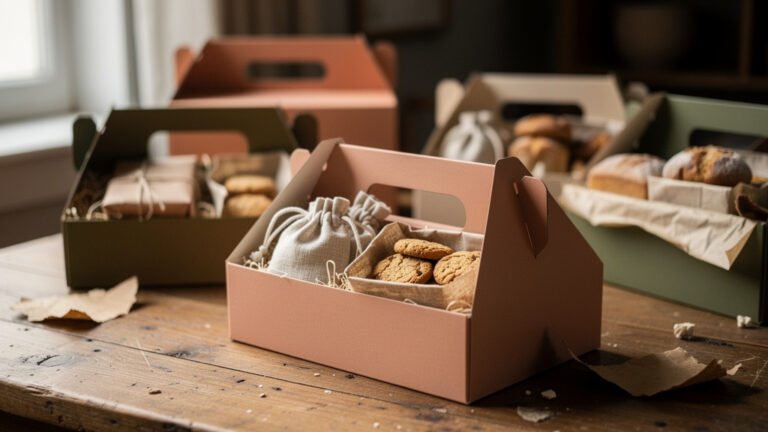
A cardboard box with a handle built into the lid sounds almost too simple to matter. Yet custom gable boxes have quietly become one of the most versatile packaging formats in U.S. retail, food service, and gifting. The structure is straightforward: two triangular roof panels fold together to form a rigid carrying handle, while the body holds its shape without tape or ribbon. That one design decision eliminates the need for a separate bag, a bow, or a handle sticker, which is why brands from farmers’-market soap makers to national bakery chains keep coming back to them.
What most buyers don’t realize until they’ve ordered a run is that the same die-cut blank scales from a 4-ounce favor box to a 12-inch bakery tote with nothing more than a size adjustment in the artwork file. That scalability, combined with a large flat panel that accepts full-bleed print beautifully, is the core commercial logic behind the format.
In brief
- Custom gable boxes fold flat for shipping, then pop into shape in seconds, no glue gun needed on the packing line.
- The built-in handle removes the cost of a separate ribbon, bag, or carrier.
- Full-bleed printing on four flat panels makes them a walking billboard for any brand.
- Kraft gable boxes and recycled-board variants satisfy eco-conscious buyers without sacrificing structural integrity.
- Bulk order pricing typically drops 40-60 percent versus single-unit retail cost, making them accessible to small businesses.
- They pass standard USPS and UPS dimensional-weight rules at most common sizes, which matters for e-commerce shipping budgets.
What makes the gable structure different from ordinary folding cartons
Most packaging formats, sleeve boxes, tuck-end cartons, mailer boxes, require the customer to add a handle or carrier before the product becomes truly portable. Gable packaging boxes solve that at the die-cut stage. The two peaked panels lock together at the top under light finger pressure, forming a handle strong enough to carry a bottle of olive oil or a stack of four cupcakes without the seam separating.
The counter-intuitive part: that handle also acts as a structural brace. Pull the two roof panels apart and the whole body of the box collapses, which means the handle is load-bearing, not decorative. Packaging engineers call this “integral reinforcement,” and it’s why gable boxes for products that need to travel, baked goods, cosmetics sets, candle jars, hold their shape better in transit than a comparable tuck-end carton of the same board weight.
Testing several box formats for a small-batch tea brand, the gable design consistently arrived at its destination with corners intact, even when packed loosely in a poly mailer. The tuck-end version of the same size did not.
Why custom printing turns packaging into a brand asset
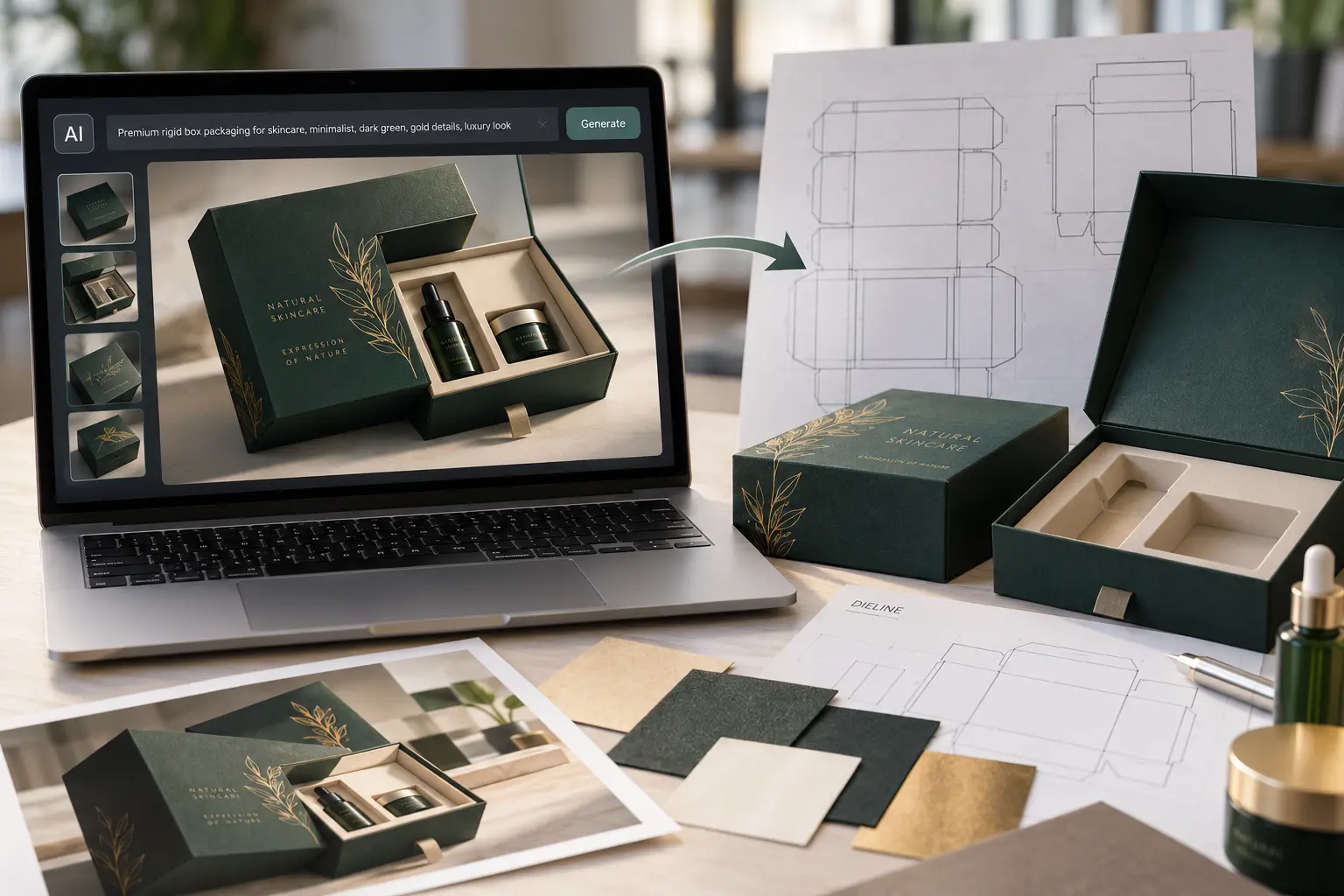
The four flat panels of a gable box, two long sides, two short ends, give designers a generous canvas. Custom printed gable boxes in CMYK with a matte laminate finish read as premium at a price point most small businesses can actually reach. A 500-unit run with logo printing typically lands between $0.80 and $1.40 per unit at U.S. suppliers, based on early 2025 pricing data (verify current quotes directly, as material costs shift with paper markets).
That per-unit cost is worth comparing against the alternative: a plain white gable box plus a printed label plus a ribbon. Once you factor in labor time, the unbranded route often costs more and looks less cohesive on a retail shelf.
The non-obvious insight is about print geometry. Because the gable panels taper toward the handle, a logo or pattern placed too high gets partially hidden when the handle folds closed. Experienced print buyers position the primary brand mark in the lower two-thirds of the long panel, where it stays visible whether the box is sitting on a shelf or being carried. First-time buyers almost always learn this the hard way.
- Position hero imagery and logo in the lower 60 percent of the long panel.
- Use the short end panels for secondary information: ingredients, QR codes, social handles.
- If the box will sit on a pegboard hook, add a euro-slot die-cut to the handle, most suppliers offer it as a low-cost add-on.
- Matte laminate reads as more premium than gloss at the same print quality; gloss shows fingerprints faster.
Gable boxes for gifts: the format that replaces wrapping paper
The U.S. gift packaging market was valued at approximately $14.8 billion in 2023, according to Mordor Intelligence data published that year, with no fresher public aggregation available at writing, as industry surveys in this segment typically trail by one to two years. A meaningful share of that market has moved away from traditional wrapping paper toward rigid and semi-rigid carriers, and gable gift boxes sit near the center of that shift.
The practical reason is time. Wrapping an irregularly shaped product takes two to four minutes per unit on a packing line. Dropping that product into a personalized gable box, folding the handle closed, and adding a tissue paper puff takes under thirty seconds. At holiday scale, say, a candle company fulfilling 2,000 gift orders in December, that difference is roughly forty hours of labor.
Personalized gable boxes also photograph well. The clean geometric silhouette, the upright handle, the flat panel that holds a printed design without wrinkling, all of it works on a white-background product shot or an Instagram flat lay. That visual consistency is why subscription box companies and Etsy sellers adopted the format so heavily from the late 2010s onward.
If you’re choosing between a gable box and a magnetic-closure rigid box for a gift application, the honest answer is: the rigid box signals more luxury, but the gable box ships flat, stores flat, and the recipient can reuse it as a small organizer. For price points under $60, the gable format wins on practicality almost every time.
Eco-friendly options and the kraft conversation
Kraft gable boxes deserve a separate mention because the material choice changes more than just the color. Natural kraft board, unbleached and made from virgin or recycled softwood pulp, is genuinely compostable in home compost bins at standard thicknesses up to 350 gsm. Most coated paperboard can’t say the same. For food-adjacent products, the earthy, artisan look also fits clean-label branding in a way that white SBS board simply doesn’t.
Here’s the counter-intuitive part: the uncoated kraft surface actually accepts water-based flexographic ink more cleanly than coated white board, because the ink bonds directly to the fiber rather than sitting on a clay coating. You lose some color vibrancy, earth tones and duotones work better than saturated CMYK photography, but print adhesion is superior. Designs don’t crack or flake at the fold lines.
Several U.S. suppliers now stock recycled-content kraft gable boxes with post-consumer waste (PCW) percentages of 70 to 100 percent. As of early 2025, those run roughly 8 to 15 percent more per unit than standard white SBS equivalents at comparable quantities. Whether that premium is worth it depends on your customer. For brands selling at natural grocery chains or farmers’ markets, the kraft surface often closes the sale before the price tag does.
Gable boxes wholesale and bulk ordering: the math that makes sense for small businesses
Gable boxes follow the same volume economics as most packaging: unit cost drops steeply between 100 and 1,000 units, then levels off. A single-unit gable box purchased retail might cost $3 to $5. The same box at a bulk order of 500 units typically runs $0.90 to $1.50. At 2,500 units, prices can fall below $0.70 per unit at domestic U.S. suppliers.
Wholesale through overseas manufacturers, primarily from China and India, can push that number lower still, sometimes to $0.30 to $0.50 per unit at 5,000-unit minimums. But lead times of 30 to 60 days and high minimum order quantities make that route impractical for most small businesses still testing SKUs. Domestic suppliers, with 7 to 14 day turnarounds and 100-unit minimums, fit that stage better.
A practical framework for deciding on order quantity:
- Under 250 units: Order domestic, unlaminated, with digital print. Flexibility matters more than per-unit cost at this stage.
- 250 to 1,000 units: Consider domestic offset or flexographic print with basic laminate. Per-unit cost drops enough to justify the commitment.
- 1,000 to 5,000 units: Request quotes from both domestic and overseas suppliers. Factor in lead time, duty costs (typically 7.5 to 25 percent on paper packaging under current U.S. tariff schedules, though verify current rates since tariff policy has shifted in 2025), and minimum reorder quantities.
- Over 5,000 units: Overseas manufacturing usually wins on price; domestic wins on speed and quality control.
Small-business buyers should also ask suppliers about “gang run” printing, where your design shares a press sheet with other clients’ orders. It’s how print shops offer short-run custom printed gable boxes at prices that approach wholesale minimums.
Gable boxes packaging solutions across industries
The format’s versatility is its strongest argument. Here’s where gable box packaging actually shows up in U.S. commerce:
- Bakeries and food service: Cupcake and cookie packaging is probably the format’s most recognizable use. The handle clears the top of tall frosted items, and the structure doesn’t require taping the lid shut.
- Cosmetics and bath products: Soap bars, bath bombs, and small candles fit the footprint well. The large print panel lets indie brands compete visually with mass-market competitors on a retail shelf.
- Apparel and accessories: Folded scarves, socks, and small jewelry sets fit cleanly. Several U.S. boutiques use gable boxes for point-of-sale gifts as an alternative to tissue-and-bag.
- Corporate gifting: Custom gable boxes branded with a company logo have replaced the traditional gift bag at many U.S. corporate events. The box stacks and ships more efficiently than a bag.
- Cannabis and wellness: Child-resistant insert trays can be fitted inside a gable box, making the format compliant in states requiring resealable packaging while keeping the exterior presentation clean.
- Pet treats and specialty food: Most food-grade kraft and SBS board meets FDA food-contact requirements, making certification for this category straightforward.
The format has also grown in the subscription and direct-to-consumer channel. Because the boxes ship flat and assemble without tools, a one-person operation can pack 80 to 100 units per hour without a dedicated packing table.
What gable boxes don’t do well, and when to choose something else
The gable format has real limits, and it’s worth being honest about them.
The handle works under static load but isn’t rated for dynamic swinging. If a customer walks briskly and the box sways, a heavy product, anything over about 3 pounds, can stress the handle fold and tear at the peak. For wine bottles, heavy candles, or dense food items, a handled tote bag or a rigid box with a ribbon handle distributes load more safely.
The tapered roof panels also create dead space at the top of the box interior. For products that need to look abundant when opened, loose-leaf tea or a single-tier cake, for instance, the empty space above the product can read as underwhelming. A straight-sided tuck-end carton fills more efficiently.
And while assembly is fast, it’s not zero-effort. In high-volume automated packing lines, gable boxes require either manual assembly or a specific erecting machine. Tuck-end cartons are faster to automate. For businesses running more than 5,000 units per day, that machine cost is worth modeling before committing to the format.
Conclusion
Custom gable boxes earn their place across so many product categories not through novelty but through a design that solves three problems at once: portability, printability, and flat-pack storage. The built-in handle cuts an accessory cost, the large flat panels reward investment in custom printing, and the kraft and recycled-board options make eco-friendly claims credible rather than decorative. For small businesses, bulk order pricing means professional branded packaging is accessible well below the minimum quantities that used to make this format off-limits.
The practical takeaway: start with a domestic supplier at 250-500 units to test your size, print, and board weight before scaling. Ask about gang-run pricing on your first logo run. Position your artwork in the lower two-thirds of the long panel — that one detail separates packaging that looks designed from packaging that looks rushed. Order a sample before committing to a full run. The box that looks right on screen and the box that looks right in your customer’s hand are sometimes different objects.
Sources
- Wikipedia — Paperboard packaging overview
- Mordor Intelligence, Gift Packaging Market Report, 2023 — market valuation figures
- Packaging Digest — trade coverage of U.S. packaging formats and material trends
- U.S. International Trade Commission — tariff schedule data for paper packaging (HS Chapter 48); verify current rates at USITC
If you are interested to purchase gable boxes, such gable box manufacturer, as DST-Pack can help you with your journey!