Over the last decade, direct-to-consumer brands have completely transformed the way products are sold. Instead of relying entirely on retail stores or distributors, modern businesses now build relationships directly with customers through their own websites, social media platforms, and online communities.
This model has created enormous opportunities for emerging brands. Small companies can now compete globally without needing physical retail space or massive distribution networks. But at the same time, it has also created a new challenge: how do you create a strong brand experience when your customer only interacts with you online?
For DTC brands, packaging has become one of the most important answers to that question.
Today, packaging is no longer just a protective shipping solution. It has become part of marketing, branding, customer retention, and overall customer experience. In many cases, the packaging itself influences how premium, trustworthy, or memorable a brand feels.
For online businesses especially, packaging often becomes the very first physical interaction between the customer and the company.
Why Packaging Matters More for DTC Brands
Traditional retail brands have many ways to influence customers before a purchase happens. People can walk into stores, compare products physically, touch materials, and interact with displays or sales staff.
DTC brands do not have those advantages.
Everything before delivery happens digitally. Customers see product photos, videos, ads, and social media content — but they cannot physically experience the product until the package arrives.
This means the first real-world impression happens at the moment of delivery.
That moment is far more important than many brands initially realize.
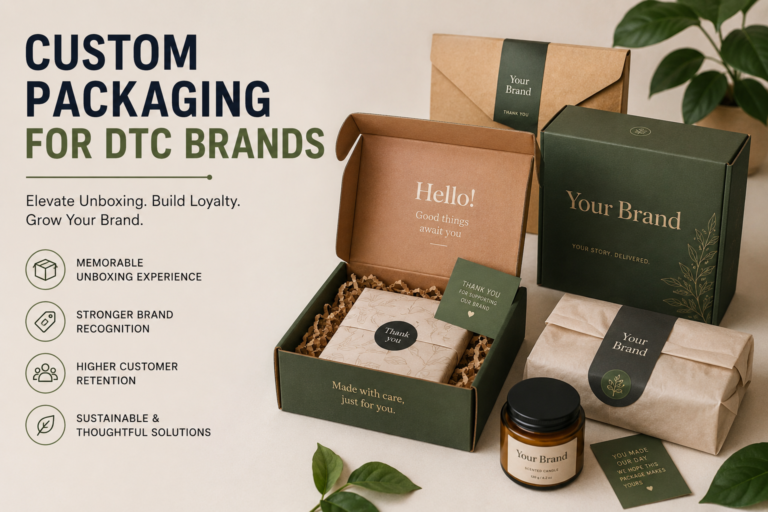
The quality of the box, the opening experience, the presentation of the product inside, the structure of inserts, and even the texture of materials all influence how customers emotionally perceive the brand.
A generic shipping box may deliver the product successfully, but it rarely creates excitement or emotional attachment. On the other hand, thoughtful custom packaging can immediately make a brand feel more premium, trustworthy, and professional.
The Unboxing Experience Is Now Part of the Product
One of the biggest shifts in modern e-commerce is the rise of the unboxing experience.
Customers no longer buy only products — they buy experiences. This is especially true in industries like cosmetics, perfume, fashion, wellness, supplements, and luxury lifestyle products.
When customers open a package, they are forming opinions not only about the item itself, but about the entire brand behind it.
The structure of the packaging, the sequence of opening, the organization of products inside, the printing finishes, and the overall presentation all contribute to the emotional impact of the experience.
This is one reason why unboxing videos have become so popular on platforms like TikTok, Instagram, and YouTube. Packaging itself has become content.
For DTC brands, this creates an opportunity that traditional advertising cannot fully replicate. A strong unboxing experience encourages customers to share products organically online, creating free visibility and social proof.
Custom Packaging Helps Build Brand Recognition
The online market is crowded. In almost every product category, customers are exposed to countless advertisements and competing brands every day.
Because of this, brand recognition has become extremely important.
Custom packaging helps create consistency between the online and physical experience. When the visual language of the packaging matches the website, social media, and advertising style, the entire brand feels more cohesive and memorable.
This consistency builds trust.
Customers are more likely to remember brands that deliver a polished and unified experience. Even relatively simple products can feel significantly more premium when supported by strong packaging presentation.
This is especially important for smaller DTC businesses trying to compete with larger established companies.
Good packaging allows smaller brands to appear more professional and premium without needing massive marketing budgets.
Packaging Influences Perceived Product Value
One of the most underestimated aspects of packaging is its influence on perceived value.
People naturally judge products based on presentation. Two identical products can feel completely different depending on how they are packaged.
This is particularly important in categories where emotional perception plays a major role, such as skincare, fragrance, candles, jewelry, or premium food products.
Luxury brands have understood this for decades. Packaging creates anticipation before the product is even touched.
For DTC brands, this becomes even more important because there is no retail environment to support the perception of quality. Packaging has to do much of that work on its own.
Premium materials, clean structural design, organized inserts, magnetic closures, embossing, foil stamping, or soft-touch finishes can all dramatically elevate the customer experience.
Packaging as a Customer Retention Tool
Many businesses focus heavily on customer acquisition while underestimating customer retention.
But for DTC brands, repeat purchases are often what determine long-term profitability.
Packaging plays a surprisingly important role in this process.
Customers remember how a brand made them feel. A positive unboxing experience creates emotional engagement, and emotional engagement increases the likelihood of repeat purchases.
In some cases, customers even keep high-quality packaging boxes for storage or display purposes. This allows the brand to remain physically present in the customer’s environment long after the purchase.
That level of brand exposure is difficult to achieve through digital advertising alone.
Sustainability Is Becoming a Major Packaging Expectation
Modern consumers are increasingly aware of environmental issues, and packaging is one of the first areas customers evaluate when judging whether a brand feels environmentally responsible.
Over-packaging, excessive plastic, and wasteful presentation can negatively affect brand perception, especially among younger consumers.
This does not mean packaging has to feel cheap or minimal. In fact, some of the strongest modern packaging combines premium aesthetics with environmentally conscious materials and efficient structural design.
Many successful DTC brands now focus on balancing visual presentation with sustainability by using recyclable materials, FSC-certified paper, soy-based inks, and optimized packaging structures that reduce waste.
Customers increasingly expect brands to think carefully about both presentation and environmental impact.
Why DTC Packaging Needs to Balance Beauty and Logistics
Unlike traditional retail packaging, DTC packaging has to survive shipping conditions directly to customers.
This creates a unique challenge.
Packaging must feel visually premium while also being durable enough to protect products during transportation.
A beautiful package that arrives damaged immediately destroys the customer experience.
This is why structural engineering becomes just as important as visual design. The best DTC packaging solutions combine aesthetics, protection, efficiency, and practical shipping considerations.
Brands that overlook this balance often face damaged products, higher return rates, and negative customer reviews.
The Future of DTC Packaging
As e-commerce continues growing, packaging will likely become even more important for direct-to-consumer businesses.
Customers increasingly expect packaging to feel personalized, intentional, and aligned with brand identity.
We are already seeing growth in areas such as smart packaging, QR-code interactions, reusable packaging systems, personalized inserts, and subscription-focused packaging concepts.
At the same time, minimalism and sustainability continue influencing modern packaging trends.
The brands that succeed long-term will likely be those that understand packaging not simply as a shipping necessity, but as part of the overall customer experience strategy.
Final Thoughts
For DTC brands, packaging is no longer just about delivering products safely.
It influences brand perception, customer retention, social media visibility, emotional engagement, and perceived value. In many cases, it becomes one of the most important physical touchpoints between the customer and the brand.
As online competition continues increasing, thoughtful custom packaging is becoming less of a luxury and more of a business necessity.
Brands that invest in strong packaging experiences often build stronger emotional connections, higher customer loyalty, and better long-term brand recognition.
If you are looking to create premium custom packaging for your DTC brand, just contact DST-Pack to discuss tailored packaging solutions designed specifically for modern e-commerce businesses.