Custom packaging is in the middle of a structural shift. Not the kind that happens gradually over a decade and is only visible in retrospect the kind that is already underway, driven by converging regulatory, technological, and commercial forces that are changing what packaging is made of, what it is expected to do, and which brands can access it.
By 2027, several changes that are currently emerging will be established practice. Brands that understand them now have a meaningful advantage over those who will discover them reactively.
This analysis draws on current industry data, regulatory timetables, and commercial trends to map where custom packaging is heading and what it means for brands making packaging decisions today.
1. Sustainability Moves from Claim to Compliance
The most consequential change happening in custom packaging is the shift from voluntary sustainability to mandatory compliance. This is no longer a trend. It is a regulatory reality with fixed deadlines.
The EU Packaging and Packaging Waste Regulation (PPWR), which entered force in January 2025, requires all packaging sold in the EU to be recyclable by 2030, with progressive targets between now and then. According to Innova Market Insights, the top packaging trend for 2026 is Substantiated Sustainability, driven precisely by these regulations and by consumers who are willing to pay more for sustainable packaging but increasingly wary of greenwashing. California’s SB 54 requires all single-use plastic packaging sold in California to be recyclable or compostable by 2032. Extended Producer Responsibility frameworks in the UK, New York State, and across Europe are adding reporting requirements that are already active.
As Creative Retail Packaging notes: regulations are now rewriting the rules on materials. Mono-material design, PCR content requirements, and EPR fees determine what brands can and cannot use. By 2027, the question will not be whether packaging is sustainable. It will be whether brands can document that their packaging meets the specific recyclability and material requirements of each market they sell into.
For paper-based rigid packaging, this regulatory shift is favorable. Paperboard is widely accepted in curbside recycling systems across the EU, US, and UK. The same source identifies paperization as a major structural trend, with FSC-certified paper at the forefront because it allows brands to credibly reduce Scope 3 emissions and typically attracts lower EPR fees than non-recyclable alternatives.
2. The End of Greenwashing: Verified Claims Become Standard
Parallel to the regulatory shift on materials, tolerance for unverified environmental claims on packaging is ending. The EU Green Claims Directive will prohibit vague environmental language unless backed by third-party verified lifecycle analysis. Terms like eco-friendly, green, or environmentally conscious without certification will be prohibited in EU markets.
Innova Market Insights puts it directly: for suppliers and brands, this shifts investment from claims-led innovation to data-backed compliance and traceability.
Creative Retail Packaging documents an emerging response to this pressure: carbon labels printed directly on packaging that detail emissions associated with a product’s lifecycle. Retailers are beginning to print carbon footprint data on pack, empowering consumers to make eco-conscious decisions the same way nutritional labels enabled health-conscious food choices.
By 2027, brands will need to back sustainability claims with documented evidence or remove them. Packaging suppliers who provide full material documentation, FSC chain of custody certificates, and food contact compliance records will have a distinct advantage over those who can only offer verbal assurances.
3. AI Enters the Packaging Brief
Artificial intelligence is already reshaping packaging design, production, and quality control, and its impact will be significantly more visible by 2027.
According to Spocket, the global market for AI in packaging is projected to reach $23 billion by 2034, and 72% of packaging companies currently using AI report higher customer satisfaction. AI enables mass customization that was previously impossible, allowing brands to generate region-specific visuals and messaging, create short-run SKUs tailored to events or demographics, and automate layout decisions.
On the production side, PMMI’s 2026 report Building an AI Advantage in Packaging Equipment identifies the biggest benefits as sharing knowledge across production teams, predicting maintenance needs, meeting regulatory requirements, and making operational data easier to interpret. AI is moving from experimentation to everyday operational use.
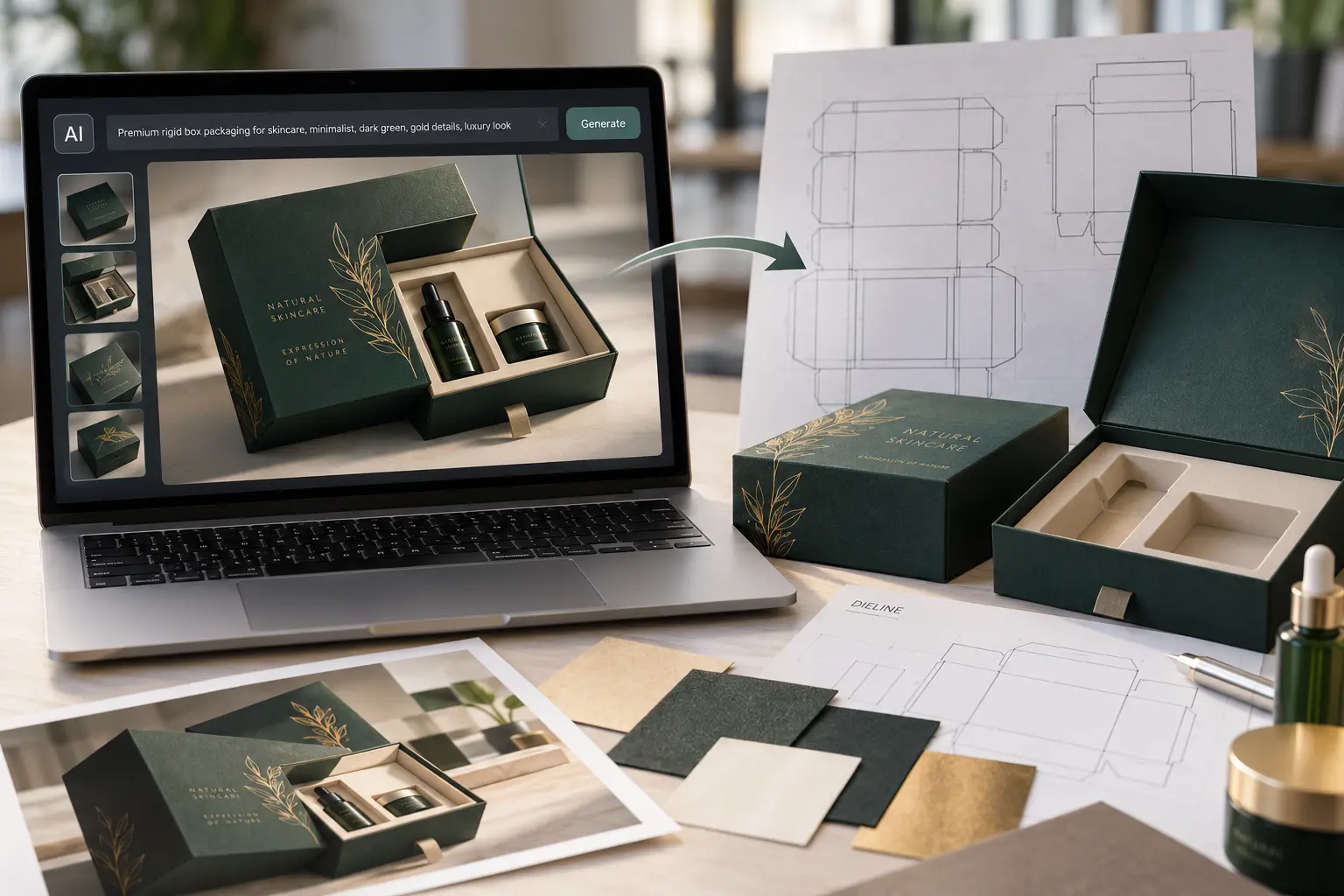
For brands, the most immediate AI impact will be in design iteration. AI tools generate multiple packaging concepts from a brief, test visual performance across different retail environments, and predict which designs will perform best with specific demographics. Some brands are already prototyping packaging that adapts based on context, adjusting typography and contrast depending on whether the product is displayed in-store, online, or through AR.
What will not change is the requirement for physical sample approval before production. AI can generate and iterate design concepts at speed, but the tactile quality of a rigid box, the weight of the board, and the precision of a foil stamp can only be verified by holding the actual physical object.
4. Smart Packaging and the 2027 Barcode Revolution
QR codes on packaging are not new, but their role is changing significantly. GS1’s Sunrise 2027 initiative is replacing traditional 1D barcodes (UPC and EAN) with 2D codes, including QR codes and DataMatrix, across global retail environments. By 2027, brands selling through major retailers in the US and EU will need to ensure their packaging meets the new 2D barcode requirements. This is not a trend to evaluate, it is a compliance deadline.
Innova Market Insights reports a 28% CAGR in global food and beverage launches with QR codes from 2021 to 2025, and 61% of global consumers say they at least sometimes interact with connected packaging. Creative Retail Packaging identifies smart packaging as turning boxes into business tools, with NFC chips, RFID tags, and AR experiences creating new revenue and engagement opportunities inside every package.
For premium rigid box packaging, these elements create new value: a QR code on the base of a luxury chocolate box linking to cacao provenance and production notes; an NFC chip in a wine gift box linking to vintage tasting notes and food pairing recommendations. These additions cost little relative to the packaging investment but significantly increase the experiential return on that investment.
5. Personalization at Scale Becomes Achievable
Variable data printing, which allows different text, imagery, or codes to be printed on individual units within the same production run, is becoming accessible at quantities that previously only made sense for very large brands.
Creative Retail Packaging identifies personalization driving loyalty at scale as a leading 2026 packaging trend, noting that variable data printing lets brands customize packaging for individual customers without increasing production costs significantly.
By 2027, brands will routinely produce packaging where individual units carry personalized elements: a customer’s name, a specific occasion message, a regional variant. This is particularly valuable for corporate gifting, subscription boxes, and premium DTC brands where the personalization of the unboxing experience is a measurable loyalty driver.
The combination of AI-generated design variation and variable data printing creates a scenario where a brand can produce 500 units of a gift box in which each one carries a different personalized element, without the cost overhead that would have made this economically impossible even five years ago.
6. Tactile Premium Deepens as Digital Noise Increases
In an era of AI-generated imagery and digital saturation, the physical experience of premium packaging is becoming more valuable, not less. This is counterintuitive but well-supported by current data.
Creative Retail Packaging identifies tactile and visual design as a primary shelf differentiator in 2026: soft-touch coatings, heritage typography, and bold geometry give brands advantages that generic packaging cannot match. When everything digital looks polished, physical differentiation becomes more meaningful.
Inuru documents a broader shift: brands moving from static graphics to active interfaces, using tactile cues and simplified structures to help consumers make faster, more confident decisions. The packaging is becoming less a passive container and more an active communication device.
The physical weight of a rigid box, the texture of soft-touch matte laminate, the resistance of a magnetic closure — these are experiences that cannot be faked digitally or replicated cheaply. They signal investment and quality in a way that no screen-based marketing channel can. By 2027, brands winning in premium consumer categories will be those that have treated this physical experience as a core commercial tool.
7. Minimum Order Quantities Continue Falling
One structural change that is already well underway and will be fully established by 2027 is the continued reduction in minimum order quantities for premium custom packaging.
Digital print technology and more flexible production scheduling have transformed the economics of short-run premium packaging. What required a 2,000-unit minimum a decade ago is now achievable at 100 to 300 units at comparable quality, because setup costs have fallen and production processes have been adapted for shorter runs.
This matters particularly for DTC brands testing new SKUs, seasonal product launchers, corporate gifting buyers with specific campaign quantities, and artisan producers who want premium packaging before committing to full-scale production. By 2027, accessing custom rigid box packaging at 100 to 300 units will be the established norm for quality-focused manufacturers, not the exception.
8. Supply Chain Resilience Becomes a Supplier Selection Criterion
The packaging supply chain disruptions of 2020 to 2023 left a lasting mark on how brands evaluate packaging suppliers. PMMI’s 2026 analysis confirms that manufacturers are investing heavily in automation and operational resilience specifically to address supply chain reliability challenges.
For brands, this translates into a preference for suppliers with transparent lead times, reliable reorder processes, and production capacity that does not create unpredictability. Brands that experienced seasonal packaging failures, Christmas gift packaging arriving in January, Valentine’s Day boxes missing the window, have learned that lead time reliability is worth paying for.
The practical result is consolidation of packaging supplier relationships. Brands are working with fewer suppliers more deeply. A packaging supplier who knows your specifications, holds your dieline files, and can process a reorder reliably without re-briefing is worth more than one who offers a slightly lower per-unit price but creates operational uncertainty.
What This Means for Brands Sourcing Packaging Now
The trends above are not distant projections. Most are already shaping packaging decisions being made in 2025 and 2026. The brands best positioned in 2027 are acting on them now.
On materials: specify paper-based rigid box packaging with FSC certification and documented recyclability. Have the material data sheet from your supplier before you need it for a retailer requirement or regulatory audit.
On sustainability claims: remove vague language from packaging now. Replace it with specific, verifiable claims backed by certifiable material data.
On barcodes: plan for 2D barcode integration if you sell through major retail channels. The GS1 Sunrise 2027 transition has a fixed deadline.
On personalization: evaluate whether variable data printing adds value to your current program. For corporate gifting, subscription, and premium DTC brands, the answer is increasingly yes.
On supplier relationships: treat your packaging supplier as a production partner. The lead time reliability, material knowledge, and reorder consistency of a long-term relationship are becoming competitive advantages as the market grows more complex.
DST-Pack and the Future of Custom Packaging
DST-Pack produces fully custom paper and rigid box packaging for brands across the US and Europe. Our production uses FSC-certified materials with full material documentation, supports compliance with EU PPWR and California SB 54 material requirements, and starts from 100 units. Every order begins with a physical sample before production starts, because in a world where AI can generate beautiful packaging mockups, the physical sample remains the only way to verify what your customer will actually hold.