Most brands that come to us for custom packaging aren’t ready to commit to a large production run on day one — and they shouldn’t have to be. A new SKU, a redesigned box, or a first attempt at premium packaging is a hypothesis, not a certainty. The smart move is to test it in market before committing serious capital to inventory.
We see this pattern often enough that it’s worth documenting: a brand places a small test order — sometimes as low as 200 or 300 units — to validate that the new packaging actually moves the needle before scaling into a full production run. Below are two anonymized case studies from brands we’ve worked with over the past two years: a chocolate brand in the United States and a cosmetics brand in France. Names, exact figures, and identifying details have been changed or generalized at the clients’ request, but the shape of each story — the test order, the reorder trigger, and the scale-up — is accurate to what happened.
Case Study 1: A US Chocolate Brand — From a 200-Unit Test to a Standing Quarterly Order
The starting point
The brand, a small-batch chocolate maker based in the northeastern United States, had been selling through farmers markets and a handful of independent retailers using a simple printed carton sourced from a generic supplier. The chocolate itself had a strong following locally, but the packaging didn’t reflect the price point — the brand was positioned at a premium, but the box looked like a mid-tier grocery item.
The founder’s core concern going into a packaging redesign wasn’t aesthetics for their own sake. It was a specific, common worry for a small operation: what if we spend real money on new boxes and they don’t actually sell better?Committing to a standard minimum order of 1,000–2,500 units — the level many packaging suppliers require — felt like too much risk for an unproven design.
The test order
We worked with the brand on a rigid magnetic-closure box with a debossed logo and a two-color interior print, designed to signal the same quality tier as the chocolate inside. Rather than push for a full production run, the brand ordered 200 units — enough to supply a single wholesale account and a few weekends of farmers market sales, with a small buffer held back for the founder’s own testing and photography.
The 200-unit order let the brand answer three questions cheaply:
- Did the new packaging change the conversation at the point of sale?
- Did it affect sell-through with the one wholesale account carrying it?
- Was there any organic social sharing — the kind that’s common with premium chocolate packaging but never guaranteed?
What happened
Within about six weeks, the brand had a clear signal. The wholesale account that received the new packaging reported a noticeably faster sell-through rate compared to an identical SKU still shipping in the old carton, and the founder began seeing the boxes show up in customer photos on Instagram unprompted — something that had essentially never happened with the previous packaging. A second wholesale account, seeing the new box, asked to carry the line for the first time.
That was enough to justify a reorder. The brand didn’t jump straight to a large industrial run — the next order stepped up to roughly 1,200 units, sized to cover the next quarter across both wholesale accounts plus direct sales. That order sold through faster than projected, and the order after that scaled again, to a standing quarterly order in the 3,000–4,000 unit range, which is where the brand’s packaging volume has stabilized as of this year.
It’s worth noting what didn’t change between the test and the scale-up: the box design itself stayed almost identical. The founder made one small adjustment after the first 200 units — moving the debossed logo slightly higher on the lid so it stayed visible when the box sat on a shelf behind other products — but the core construction, the closure type, and the interior print all carried through unchanged into the larger runs. That’s a detail worth calling out, because it’s a common misconception that a test order is meant to trigger a redesign. More often, its job is simply to confirm that the first design decision was the right one, so the brand can scale it with confidence rather than iterating blind.
The timeline also matters here. From the initial 200-unit order to the standing quarterly reorder took roughly seven months — not an overnight jump, but a fast one by the standards of a small food and beverage brand managing production, cash flow, and wholesale relationships largely on its own. The founder later noted that having a fixed reorder point tied to actual sell-through data, rather than a seasonal guess, made cash flow planning noticeably easier: they knew roughly how many units the current packaging would move before they needed to place the next order, because the first two cycles had already established the pattern.
Why the small test mattered
The founder’s own assessment, relayed to us afterward, was straightforward: the test order didn’t just de-risk the packaging spend — it gave the brand real data to bring to new wholesale conversations. Instead of pitching a redesign on instinct, they could point to an actual sell-through comparison from a live account. That made the case for expanded retail placement much easier to make, and it meant the eventual larger order was backed by evidence rather than a bet.
Case Study 2: A French Cosmetics Brand — From 300 Units to a Six-Figure Annual Run
The starting point
The second brand is an independent skincare line based in France, selling primarily direct-to-consumer with a small presence in a handful of concept stores in Paris and Lyon. The founder had built the product formulations carefully over several years but was launching a new limited line — a three-piece gift set — without any track record for how gift packaging specifically would perform for the brand’s audience.
French cosmetics buyers, both consumers and the concept-store buyers who stock independent lines, are unusually discerning about packaging; it’s one of the most design-literate markets in the world for this category. The founder didn’t want to guess at what would land. There was also a compliance dimension: any packaging produced for the French market needed material documentation suitable for the brand’s CITEO (REP Emballages) declaration, which meant the packaging decision wasn’t purely aesthetic — it had a regulatory backend to get right from the first order.
The test order
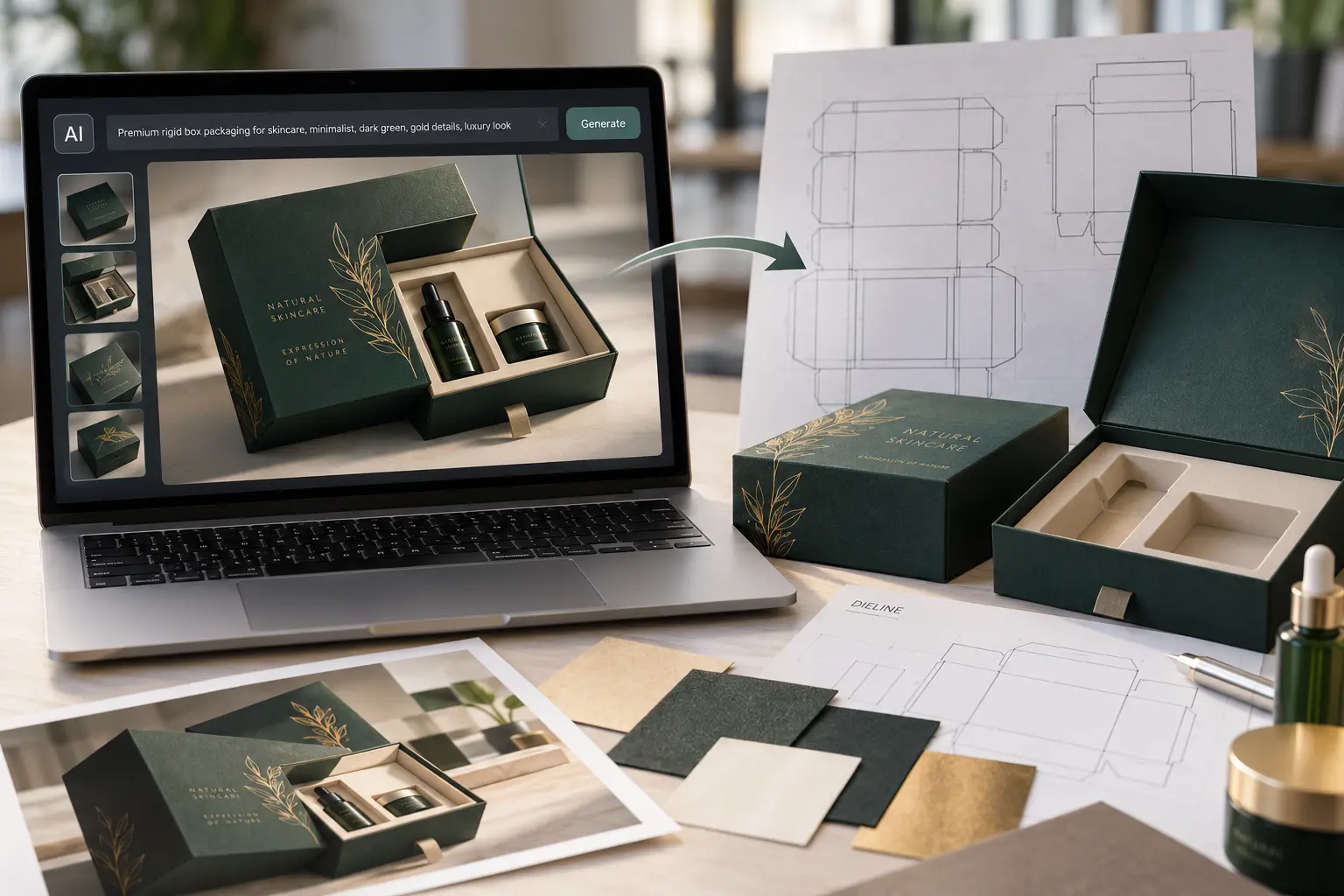
We produced a rigid drawer-style box with a custom insert holding the three products securely, using an FSC-certified matte paper stock with a single spot-UV detail on the lid. The brand ordered 300 units for an initial holiday-season test — enough to launch through the brand’s own website and place a small allocation with two of the concept stores that had expressed interest, without overcommitting inventory on a gift set that had no sales history.
What happened
The gift set sold out faster than any other SKU the brand had launched that year. Both concept stores reordered within three weeks, and one specifically asked for a larger allocation for the following month, citing customer requests. On the DTC side, the brand’s own site data showed the gift set converting at a meaningfully higher rate than its individual full-price products sold separately — a strong signal that the packaging itself, not just the underlying products, was doing real work in the purchase decision.
The brand came back for a second order of roughly 1,500 units to cover the remainder of the holiday season, and by the following year had moved to a standing production plan that now runs in the low tens of thousands of units annually across two seasonal gift-set variations. What started as a single limited holiday test became one of the brand’s highest-margin recurring product lines.
The reorder wasn’t quite a straight repeat of the original 300-unit box, though. Between the first and second orders, the brand added a small ribbon closure detail after hearing directly from concept-store buyers that customers were asking whether the set was meant to be a gift — a signal the box needed to communicate that more explicitly at a glance, without a customer having to read the label. That single addition came directly out of retail feedback gathered during the test phase, which is arguably the more valuable outcome of a small first order: not just a go/no-go signal, but specific, low-cost information about what to adjust before scaling.
By the second holiday season, the brand had also expanded the gift set concept into a smaller travel-size version at a lower price point, using a simplified version of the same drawer-box construction. That variation wouldn’t have been a low-risk decision to test at full production volume either — but having already validated the core construction and compliance documentation on the original set meant the second SKU could go from concept to test order in a matter of weeks rather than months, since much of the groundwork (the material sourcing, the FSC certification, the CITEO documentation) was already in place and simply needed adapting to a new box size.
Why the small test mattered
For a founder managing formulation, compliance, retail relationships, and a small team all at once, the 300-unit order removed the single biggest source of hesitation: the fear of sitting on unsold premium inventory. It also meant that by the time the brand scaled up, the material documentation and compliance groundwork were already in place — there was no scramble to retrofit CITEO paperwork onto a much larger order under time pressure.
The Pattern Behind Both Stories
Different countries, different categories, but the same underlying shape:
- A test order at a genuinely low quantity — 200 to 300 units — sized to answer a specific question rather than to be economical on a per-unit basis.
- A measurable signal within weeks, not months: faster sell-through, unprompted social sharing, reorders from existing accounts, or a conversion-rate lift that could be directly attributed to the new packaging.
- A stepped scale-up, not a single leap from test to full volume — each brand grew into a larger order size as demand confirmed itself, rather than betting the whole budget on the first reorder.
Neither brand could have gotten this data from a supplier requiring a 1,000+ unit minimum on an unproven design. The ability to order in small, real-world test quantities — and still get premium material quality and full compliance documentation at that volume — was what made the eventual scale-up possible in the first place.
If You’re Testing a New Box Before You Commit
Both of these brands started the same way every project starts with us: a brief, a conversation about what the packaging needs to prove, and a small physical sample before any production run — test or otherwise. If you’re sitting on a redesign you’re not sure is worth the investment, that’s exactly the kind of decision a low-quantity test order is built for.