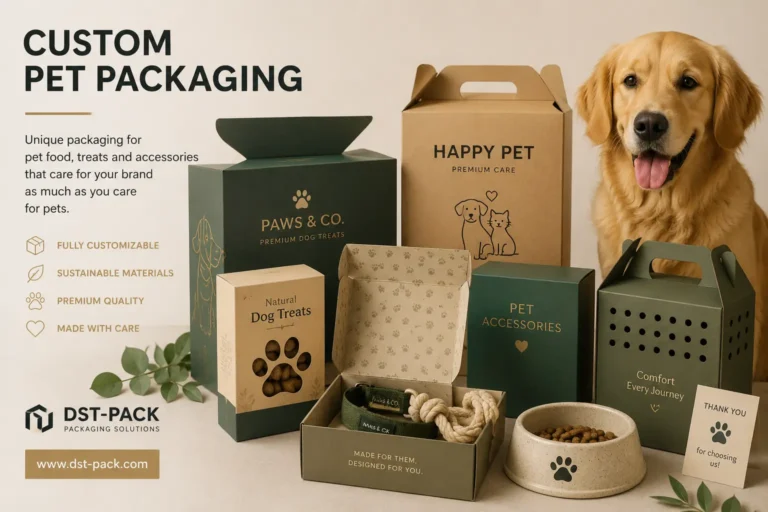
The pet industry is one of the most emotionally driven consumer categories in retail. People don’t just buy pet products — they buy trust, care, and a sense of doing right by an animal they love. That emotional weight makes packaging far more important than it might seem at first glance. A box isn’t just a container in this category; it’s the first physical proof a customer has that a brand takes quality seriously.
Custom cardboard packaging has become the default choice for pet brands that want to compete on more than just price. It’s lightweight, cost-effective to produce and ship, fully customizable, and — increasingly important to pet owners — recyclable. For brands selling treats, toys, grooming products, supplements, or subscription boxes, packaging is often the difference between a one-time purchase and a repeat customer.
Why Packaging Matters So Much in the Pet Category
Pet products compete in an unusually crowded and visually noisy market, whether on a shelf or in an online storefront. A few factors make packaging especially high-stakes here:
- Trust signals matter more than usual. Pet owners are buying on behalf of another living being, which raises the emotional stakes of every purchase decision. Clear ingredient information, safety certifications, and a premium look and feel all help reduce purchase anxiety.
- Unboxing drives repeat purchases and reviews. Subscription boxes and DTC pet brands rely heavily on the unboxing moment for social sharing and customer retention. A flat, generic box undersells a product that customers already feel emotionally invested in.
- Function and durability aren’t optional. Kibble, treats, and supplements need moisture resistance and structural integrity; toys and accessories need packaging that survives shipping without dents or crushed corners.
- Sustainability is a purchase driver, not a nice-to-have. Pet owners increasingly research whether packaging is recyclable or compostable before buying, particularly for food and treat products purchased repeatedly.
- Shelf differentiation in a saturated category. Pet aisles at big-box retailers and specialty stores are visually dense. A structural die-cut, a distinctive finish, or an unusual box shape can be the difference between being noticed and being scrolled past.
Types of Custom Cardboard Packaging for Pet Brands
Folding cartons work well for treats, small toys, grooming kits, and supplement boxes. They’re cost-efficient at scale, print beautifully across a wide range of stock weights, and are easy to customize with die-cut windows so customers can see the product before buying. Folding cartons also fold flat for storage and shipping, which keeps warehousing costs down for growing brands.
Corrugated shipping boxes are the backbone of e-commerce pet brands. Custom-printed corrugated mailers reinforce brand identity from the moment a package lands on someone’s doorstep, and they can be engineered to the exact dimensions of the product to reduce void fill and shipping costs. For heavier items like bags of food, bedding, or crates, corrugated board also provides the load-bearing strength that folding cartons can’t match.
Rigid boxes suit premium product lines — think curated gift sets, luxury grooming kits, or limited-edition collaborations. The added structure and weight communicate quality instantly, and rigid boxes are often reused by customers for storage, which extends brand visibility well past the point of purchase.
Subscription box packaging needs to do double duty: protect a mix of different product shapes and sizes while still delivering a consistent, branded unboxing experience every single month. Insert cards, tissue paper, and custom-printed interior flaps all add to that experience without significant cost increases, and a well-engineered interior layout (dividers, trays, or fitted inserts) prevents products from shifting and colliding in transit.
Advent-calendar-style and multi-compartment boxes have started appearing in pet retail too, particularly around the holidays — a 24-day countdown box filled with small treats or toys for a dog or cat has become a popular seasonal gift item for pet-owning households. These require more complex structural engineering than a standard box, since each compartment needs to hold its shape independently while the overall box stays compact for shelf or online listing.
Retail display packaging (PDQ trays and counter displays) helps pet brands win secondary placement in stores — near checkout counters or end-caps — where impulse purchases of treats, toys, and grooming accessories are common. These are typically corrugated, printed to match the primary packaging, and designed to be shipped pre-loaded and simply dropped into place by store staff.
Design Considerations Specific to Pet Packaging
Ingredient and safety transparency. For treats and food products, clear ingredient lists, sourcing claims, and any relevant safety certifications should be easy to find on the packaging — not buried in small print. Pet owners have become as label-conscious about pet food as they are about their own groceries.
Material safety. Packaging that comes into direct contact with treats or food-adjacent products should use food-safe inks and coatings. This is worth confirming with your packaging manufacturer at the specification stage, not after the first print run, since retrofitting a food-safe barrier layer later can mean redoing the entire die-line.
Regulatory labeling. Depending on the market, pet food and treat packaging may be subject to specific labeling requirements — for instance, guaranteed analysis statements in the US, or country-of-origin marking in the EU. Regulatory frameworks around packaging waste, such as the EU’s Packaging and Packaging Waste Regulation (PPWR), are also increasingly relevant for brands shipping into European markets, since they affect recyclability requirements and material declarations. Brands selling across both US and EU markets often need two slightly different packaging specifications to stay compliant in each region.
Sizing for real shipping conditions. Pet toys and accessories vary wildly in shape — a plush toy, a rubber chew, and a stainless-steel bowl all need very different cushioning approaches. Custom die-lines built around your actual product dimensions reduce shipping costs and prevent the “swimming in the box” look that undermines a premium brand image, while also cutting down on the dimensional-weight shipping fees that oversized boxes tend to trigger.
Sustainable materials. Recycled and recyclable corrugated board, soy-based inks, and minimal plastic use are now common requests from pet brands positioning themselves as environmentally responsible — a positioning that resonates strongly with the category’s customer base. Removing plastic viewing windows in favor of die-cut openings, or switching from laminate coatings to water-based ones, are two small changes that noticeably improve a package’s end-of-life recyclability without a major cost jump.
Brand storytelling on the box itself. Because pet owners often keep packaging around longer than other categories (storage tins, treat jars, toy boxes), the interior and exterior surfaces of the box are an underused opportunity for storytelling — founder notes, care instructions, or QR codes linking to feeding guides and community content.
Cost Factors Worth Understanding Early
Custom packaging costs are driven primarily by four variables: board type and weight, number of ink colors and finishes (foil stamping, embossing, spot UV), order volume, and structural complexity (number of die-cuts, folds, and inserts). For most pet brands starting out, a single-color or two-color print on a straightforward folding carton or corrugated mailer offers the best balance of shelf impact and unit cost. More elaborate finishes are usually reserved for hero SKUs, gift sets, or limited seasonal runs, where the higher per-unit cost is offset by a higher price point or stronger marketing push.
Ordering in bulk brings per-unit costs down significantly, but brands that are still validating a new product line or a private-label SKU often benefit from a smaller initial run to test market response before committing to a large print order.
Getting Custom Packaging Right From the Start
The brands that get the most value out of custom cardboard packaging treat it as part of product development, not an afterthought bolted on before launch. That means thinking early about box dimensions relative to shipping costs, planning for both retail and e-commerce display needs if selling through multiple channels, and building in flexibility for seasonal or limited-edition runs without redesigning the entire structure each time.
Working with a manufacturer who understands both the structural engineering side of packaging and the specific regulatory and market nuances of the pet category makes this process considerably smoother — especially for brands selling across the US and EU, where labeling and packaging waste requirements differ. A good packaging partner will also flag potential shipping or durability issues at the design stage, before a print run is committed, rather than after a batch of damaged returns starts coming in.
Ready to design packaging that matches how much your customers care about their pets?