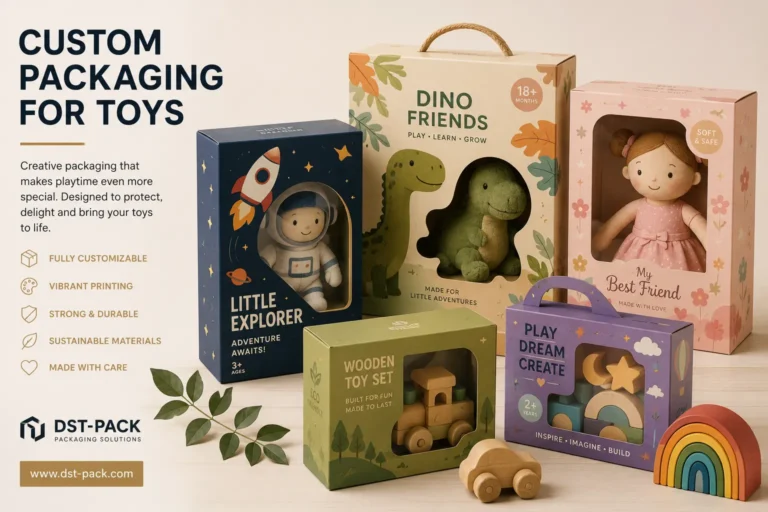
Toy packaging carries a heavier burden than almost any other product category. It has to sell the product to a parent standing in an aisle or scrolling a product page, delight the child who eventually opens it, survive a warehouse-to-doorstep journey without damage, and — critically — meet strict safety and labeling regulations that don’t apply to most other consumer goods. Very few categories ask packaging to do this much work at once.
For toy brands, custom cardboard packaging isn’t just a branding exercise. It’s a functional, regulatory, and emotional touchpoint all at the same time, and getting it right has a direct effect on shelf performance, return rates, and repeat purchases.
Why Toy Packaging Is Uniquely Demanding
It has to sell in seconds. Toy purchasing decisions, especially in physical retail, are often made quickly — a parent scanning a shelf, or a child pointing at something bright and appealing. Packaging needs strong, clear visual hierarchy: what the toy is, who it’s for, and why it’s exciting, all readable at a glance.
It has to protect fragile and oddly shaped products. Toys come in an enormous range of shapes, materials, and fragility levels — a die-cast car, a plush animal, a multi-piece playset, a battery-operated gadget. Generic boxes rarely fit any of them well, which leads to either wasted space and higher shipping costs, or products shifting and getting damaged in transit.
It’s subject to strict safety and labeling regulations. Age grading, choking hazard warnings, small parts labeling, and battery safety information are legally required in most markets and enforced closely for products aimed at children. Packaging is often where this information legally has to live, which means the design has to accommodate mandatory text and warning symbols without looking cluttered or ruining the visual appeal.
It has to survive real shipping conditions. With toy sales increasingly happening through e-commerce, boxes are handled far more roughly than they would be moving straight from a warehouse pallet to a store shelf. A box that looks great on a shoot but crushes easily in transit creates costly returns and damages trust in the brand.
Types of Custom Packaging for Toys
Printed folding cartons are the workhorse of the toy industry — used for boxed sets, action figures, small vehicles, and construction toys. They allow for vibrant, high-impact graphics, die-cut viewing windows so the product is visible on shelf, and structural inserts that hold the toy securely in place.
Blister and clamshell-style card backs combine a printed cardboard backer with a clear plastic shell, commonly used for small toys, collectibles, and accessories that need to be visible and securely fastened. Many brands are now shifting toward paperboard-only alternatives or reduced-plastic hybrids to cut down on non-recyclable materials, a shift driven both by regulation and by parent demand for less plastic packaging.
Corrugated shipping boxes protect larger toys, multi-piece sets, and anything shipped directly to consumers. Custom-fitted corrugated inserts — dividers, trays, or molded fiber cushioning — keep individual pieces from rattling around and colliding during transit, which matters enormously for playsets with dozens of small components.
Window boxes are especially common in the toy category because seeing the actual product, rather than just an illustration, builds parental confidence in a purchase — particularly for plush toys, dolls, and character-based products where the physical likeness matters.
Gift and premium packaging — rigid boxes, ribbon closures, magnetic flaps — suits collectible toys, higher-price-point items, and holiday-season product lines, where the unboxing experience itself is part of what the customer is paying for.
Retail display packaging (PDQ trays, counter displays, endcap units) helps toy brands secure impulse-purchase placement near checkout lanes or aisle ends, an especially valuable placement in the toy category where impulse buys from both children and parents are common.
Design Considerations Specific to Toy Packaging
Age grading and safety text. Packaging needs to clearly display the appropriate age range, along with any required choking hazard or small parts warnings. These elements are non-negotiable from a compliance standpoint, so it’s worth designing the overall layout around them from the start rather than squeezing them in at the end.
Material safety compliance. Depending on the target market, toy packaging materials themselves may fall under safety regulations — for instance, restrictions on certain inks, coatings, or phthalates in materials that could come into contact with a child during use. Brands selling across both the US and EU markets should confirm compliance separately for each region, since standards and testing requirements differ.
Durability engineering. A toy box needs to be evaluated not just on how it looks in product photography, but on how it performs after a drop test or a rough ride through a fulfillment center. Reinforced corners, appropriately rated board weight, and well-designed internal cushioning all reduce damage-related returns.
Bilingual and multi-market labeling. Toy brands selling across multiple countries often need to fit several languages’ worth of safety text onto the same packaging — a layout challenge that’s much easier to solve if it’s planned for at the design stage rather than retrofitted later.
Sustainability without sacrificing visibility. Reducing plastic content — smaller windows, paperboard-based blister alternatives, recycled corrugated fill — has become a meaningful differentiator for toy brands, particularly with parents who actively seek out lower-plastic options for their children’s products. This shift is also increasingly shaped by packaging waste regulation in markets like the EU, where minimizing non-recyclable materials is becoming a compliance consideration rather than just a marketing choice.
Unboxing as part of play. For character-driven or collectible toys in particular, the packaging itself can become part of the experience — a display stand that folds out of the box, a reveal mechanism, or packaging designed to be kept and displayed rather than thrown away immediately.
Cost and Volume Considerations
Toy packaging costs are shaped heavily by structural complexity — the number of internal inserts, die-cuts, and windows — more than by graphics alone. A simple printed carton with a single viewing window is one of the more economical options at scale, while multi-compartment playset boxes with fitted trays cost more per unit but significantly reduce damage-related returns, which often offsets the higher unit price over the life of the product.
As with most packaging categories, order volume matters: brands testing a new toy line or a private-label product often start with a smaller digitally printed run to validate the product and packaging design before committing to a larger, more cost-efficient offset print run once demand is confirmed.
Testing Packaging Before Committing to a Full Run
Because toy packaging combines structural, regulatory, and durability requirements all at once, testing before a full production commitment is worth the extra step. Drop tests, stack tests, and compression tests simulate what a box will actually experience in a warehouse or delivery van, and they catch weak points — a corner that crushes too easily, a window that cracks under pressure, an insert that doesn’t hold its shape — long before thousands of units are printed and shelved. For brands shipping direct-to-consumer, it’s also worth testing how a box performs in a standard carrier’s sorting and handling process specifically, since that tends to be rougher than retail distribution.
A short pilot run, whether digitally printed or produced as a physical prototype, is generally cheap insurance against a much costlier problem: discovering a structural flaw after a large print run has already shipped to a retailer or a fulfillment warehouse.
Seasonal Demand and Licensed Products
Toys are one of the most seasonal categories in retail, with a large share of annual volume concentrated around the holiday period. This creates two packaging-specific challenges. First, print runs need to be planned well in advance of peak season, since press capacity and shipping lead times both tighten as the holidays approach — waiting too long to finalize packaging can mean missing the shelf window entirely. Second, seasonal and limited-edition packaging (holiday-themed boxes, collaboration packaging, anniversary editions) often needs shorter, more flexible print runs than a brand’s core evergreen SKUs, which tends to favor digital printing even for brands that otherwise print at offset volumes for their standard lineup.
Licensed toys — those built around characters or franchises — add another layer of complexity. Licensing agreements frequently include strict brand guidelines around exact color matching, logo placement, and required legal text, all of which need sign-off from the licensor before a print run is approved. Building extra time into the production schedule for this approval step avoids last-minute delays that can push a product past its intended launch window.
Packaging for Different Toy Categories
Not all toys need the same packaging approach, and it’s worth thinking through the specific demands of a product category rather than defaulting to a generic solution:
- Plush toys and dolls benefit from softer-touch packaging — window boxes or minimal-material header cards — since the appeal is tactile and visual, and heavy structural packaging can actually work against the product’s soft, approachable positioning.
- Building sets and multi-piece toys need internal organization above almost anything else. Compartmentalized trays or bagged sub-assemblies inside a single printed carton prevent small pieces from mixing, getting lost, or damaging each other in transit.
- Battery-operated and electronic toys carry additional labeling requirements around battery safety and, in many markets, WEEE or e-waste disposal symbols, which need to be accounted for in the packaging layout from the start.
- Ride-on and larger toys typically move into heavy-duty corrugated territory, where the packaging itself often needs to double as a shipping container capable of surviving parcel-network handling without an outer shipping box.
- Collectibles and limited editions tend to justify premium packaging treatments — foil stamping, magnetic closures, display stands — since collectors frequently keep the packaging as part of the product’s perceived value.
Working With Retailers vs. Selling Direct
Packaging requirements can differ meaningfully depending on the sales channel. Big-box and specialty toy retailers often have their own packaging specifications — minimum and maximum carton dimensions, required barcode placement, specific labeling formats — that need to be confirmed before a print run, since packaging that doesn’t meet a retailer’s intake requirements can be rejected at receiving. Direct-to-consumer brands have more flexibility on box design but need to weight that against real-world shipping performance, since there’s no retail employee unboxing and re-shelving the product; it goes straight from the box to the customer’s hands.
Brands selling through both channels sometimes maintain two packaging variants for the same product — a retail-ready version built to a specific retailer’s spec, and a slightly different direct-to-consumer version optimized for shipping durability and unboxing experience rather than shelf compliance.
Getting Toy Packaging Right From the Start
The toy brands that get the most value from custom packaging treat compliance, durability, and shelf appeal as equally important from day one — not as separate problems to solve in sequence. That means involving a packaging manufacturer early enough to flag safety labeling requirements, structural weak points, and shipping durability concerns before a design is finalized and a print run is committed, rather than discovering problems after the first batch of damaged units or a compliance issue comes back from a retailer.
Looking for packaging that protects, delights, and stays compliant across markets?