The First Time Many Brands Notice It
A company orders beautifully printed corrugated packaging, the shipment arrives, and suddenly someone notices soft wave patterns appearing on the box surface under the light. Sometimes the effect is barely visible. Other times, especially on darker packaging or minimalist designs, the waves become much easier to spot.
For brands investing in premium packaging, this can immediately raise concerns. Many people assume visible waves mean the cardboard was poorly manufactured or damaged during production. In reality, that is usually not the case at all.
Visible waves are one of the most natural characteristics of corrugated cardboard packaging. They are directly connected to how corrugated material is engineered and why it became the global standard for shipping and retail packaging.
Professional packaging manufacturers such as DST-Pack custom packaging manufacturer work with corrugated materials every day and understand that slight surface movement is often simply part of the material itself rather than a defect.
To understand why these waves appear, it is important to first understand what corrugated cardboard actually is.
Corrugated Cardboard Is Built Around Waves
Unlike rigid paperboard or simple carton stock, corrugated cardboard is not a single flat sheet of paper.
It consists of multiple layers combined together:
- an outer liner paper,
- an inner liner paper,
- and a fluted paper layer placed between them.
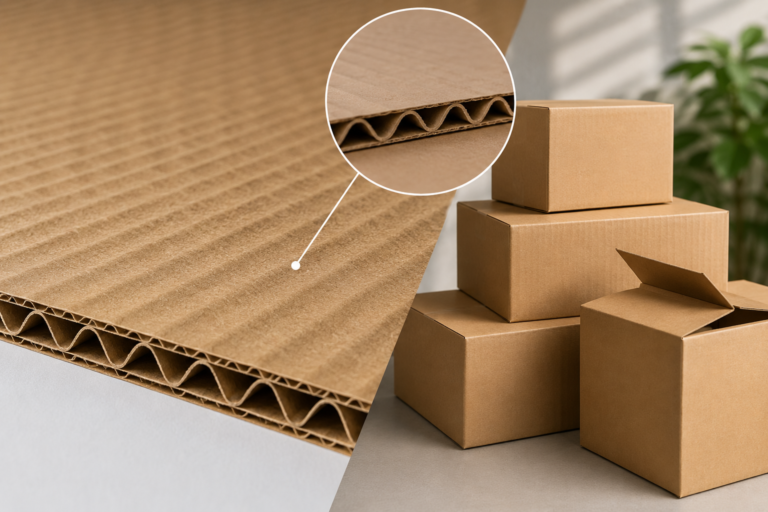
That middle layer is shaped into continuous arches or waves known as flutes. These flutes create small air pockets inside the board, which dramatically increase the material’s strength while keeping it lightweight.
The entire reason corrugated packaging performs so well during transportation is because of this internal wave structure. It absorbs impacts, distributes pressure, and helps boxes resist crushing during storage and shipping.
Without those flutes, corrugated boxes would lose most of their structural performance.
The interesting part is that the internal flute pattern never fully disappears. Even though the waves are hidden beneath the outer paper liner, their structure can sometimes become visible externally depending on lighting, humidity, printing style, and material choice.
That is where the visible wave effect comes from.
Why Waves Become Visible on the Surface
In many cases, the waves are not actually “raised” defects that you can strongly feel with your hand. Often, the effect is more visual than physical.
Light reflects differently across the surface because the internal flute slightly influences the tension and shape of the outer paper layer. Under certain angles, especially with directional lighting, the flute pattern underneath becomes easier to notice.
This effect becomes far more noticeable on:
- matte finishes,
- dark colors,
- large solid prints,
- minimalist packaging,
- and thinner top liner papers.
Black packaging is especially known for revealing flute visibility. Matte black surfaces tend to expose every tiny irregularity because light reflection becomes very sensitive on darker areas.
Meanwhile, glossy white packaging may hide the exact same flute structure much more effectively.
This is why two corrugated boxes made from identical material can appear completely different visually depending on their print design.
Humidity Changes Everything
One of the biggest reasons corrugated packaging develops more visible waves over time is humidity.
Paper is a natural material. Unlike plastic or metal, it constantly reacts to environmental conditions around it. When cardboard absorbs moisture from the air, the paper fibers expand slightly. Since corrugated board consists of several glued layers under tension, this expansion can make the flute structure underneath more visible.
This is extremely common during international logistics.
For example, packaging produced in a relatively dry factory environment may later travel through humid warehouses, sea freight containers, or changing climates. During that process, moisture levels fluctuate constantly.
Even premium packaging can begin showing stronger flute visibility after long-distance shipping.
This does not automatically indicate low quality production. It is simply part of how paper-based materials naturally behave.
In fact, many luxury brands experience this phenomenon even with high-end retail packaging.
Printing Methods Also Affect Wave Visibility
Flexographic Printing
Flexographic printing is commonly used directly on corrugated cardboard for shipping cartons and larger production runs. Since the print is applied directly onto the corrugated surface, the flute structure underneath can sometimes become more visible.
This method is highly efficient and cost-effective, but it usually does not create an ultra-smooth luxury finish.
Offset Laminated Packaging
Offset laminated corrugated packaging typically creates a cleaner and more premium appearance.
In this process, artwork is first printed onto a separate paper sheet, which is then laminated onto the corrugated board. Because the printed layer is smoother and more controlled, the final result often hides flute visibility more effectively.
However, even laminated packaging is not completely immune to visible waves, especially after exposure to humidity or changing temperatures.
Completely Flat Corrugated Packaging Is Difficult to Achieve
Many people expect corrugated packaging to look perfectly smooth like rigid board or plastic packaging. But corrugated cardboard was never designed primarily for decorative perfection.
It was designed for protection.
The internal flute structure is what gives corrugated packaging its strength. Those waves absorb impacts, support stacking pressure, and protect products during shipping.
Trying to completely eliminate all visible flute patterns would usually require:
- thicker paper layers,
- heavier materials,
- additional lamination,
- more coatings,
- and higher production costs.
In some cases, pursuing a perfectly flat appearance can even reduce the efficiency or sustainability of the packaging itself.
That is why experienced packaging manufacturers focus on balancing appearance and functionality rather than trying to eliminate every natural characteristic of corrugated material.
Different Flute Types Create Different Visual Results
Not all corrugated cardboard behaves the same way.
The flute type used inside the packaging significantly affects how visible the waves become.
Smaller flute profiles such as E flute or F flute create finer internal structures and usually provide smoother printing surfaces. These are often used for:
- cosmetics packaging,
- retail packaging,
- electronics packaging,
- and premium presentation boxes.
Larger flute structures such as B flute or C flute provide stronger cushioning and stacking resistance but may reveal more texture externally.
For heavy shipping cartons, structural performance is usually prioritized over perfectly smooth appearance.
Every corrugated packaging project involves balancing:
- aesthetics,
- protection,
- shipping performance,
- sustainability,
- and production cost.
Sustainable Packaging Naturally Has Character
Modern consumers increasingly prefer sustainable packaging solutions, and corrugated cardboard remains one of the most environmentally friendly packaging materials available.
Many corrugated boxes are produced using:
- recycled fibers,
- recyclable materials,
- water-based inks,
- and FSC-certified paper sources.
As sustainability becomes more important, brands are also becoming more accepting of natural paper textures and small visual variations.
Years ago, companies often wanted packaging to look perfectly artificial and uniform. Today, many consumers actually appreciate packaging that feels more authentic and paper-based rather than overly synthetic.
Slight visible waves are often viewed as a normal part of sustainable corrugated packaging rather than a flaw.
When Waves May Actually Indicate a Problem
Although slight wave visibility is usually normal, there are situations where excessive distortion can indicate real issues.
Severe problems may include:
- heavy warping,
- bubbling,
- delamination between layers,
- collapsed flute structures,
- or major moisture damage.
These situations are different from ordinary flute visibility and may indicate storage problems, humidity imbalance, or production defects.
However, soft visible wave patterns alone are generally considered a completely normal characteristic within the corrugated packaging industry.
Corrugated Packaging Is Designed for Performance First
At the end of the day, corrugated cardboard remains one of the most effective packaging materials in the world for a reason.
It is:
- lightweight,
- durable,
- recyclable,
- cost-efficient,
- customizable,
- and highly protective during transportation.
The same internal wave structure that occasionally becomes visible on the surface is also what gives corrugated packaging its strength and efficiency.
In other words, those visible waves are not necessarily signs of poor quality. Very often, they are simply proof that the packaging is functioning exactly as it was designed to function.