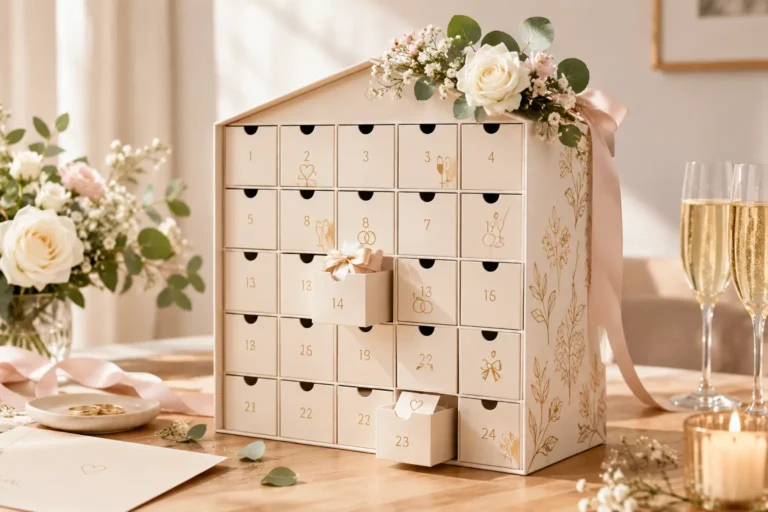
A wedding advent calendar is exactly what it sounds like: the classic countdown format, borrowed from Christmas, and rebuilt around a different date on the calendar — the wedding day. Instead of 24 doors leading to December 25th, a bride (or occasionally a couple) opens one box, drawer, or envelope a day for 7, 12, or 14 days leading up to “I do,” each one holding a small gift, task, or note from bridesmaids, a mother, or a partner.
It’s a format extension, not a new idea. The advent calendar itself has already left December behind — the global market was valued at roughly $1.87 billion in 2024 and is forecast to keep growing at an 8%+ CAGR through the early 2030s, with adult-focused and non-Christmas variants cited as the main growth driver. Wedding countdowns are one of the more visible offshoots of that shift, alongside birthday, baby-shower, and anniversary versions.
Why It’s Catching On
1. Gifting has moved from a single event to a build-up. Bridal showers and bachelorette parties already treat the wedding as a season rather than a day. An advent calendar fits that mindset — it turns the weeks before the wedding into a running sequence of small moments instead of one gift opened once.
2. It solves a real problem for bridesmaids and mothers. “What do I get the bride who’s already registered for everything” is a common gifting problem. A countdown format spreads a modest budget across several small, easy-to-source items (a sleep mask, vow-writing notebook, stain-remover pen, something borrowed/blue) rather than requiring one expensive gift.
3. Social platforms reward the format. Unboxing content performs well, and a wedding countdown naturally produces several short video moments instead of one. Search and short-video platforms have been showing a steady flow of bridal-countdown content through 2026, largely driven by maid-of-honor and bridal-party accounts rather than big brands — this is currently a grassroots, DIY-led trend more than a retail one.
4. Personalization is easy at small scale. Unlike a mass-produced 24-day chocolate calendar, a 7- or 12-day wedding version is short enough that a bridesmaid, a small gifting brand, or a wedding planner can fully customize it — names, wedding date, colors, even inside jokes — without the cost structure of a large seasonal run.
Who’s Making Them
Right now, the category splits into two groups:
- DIY and personal gifting — a bridesmaid or family member assembling a calendar from ready-made boxes or a kit, currently the larger share of activity.
- Boutique gifting brands — smaller companies packaging a pre-curated 7-to-12-day countdown (sleep mask, ring-cleaning cloths, a “minimergency kit,” etc.) as a ready-to-buy product, sold mainly through boutique e-commerce and Etsy-style marketplaces.
Neither group is well served by the mass-market advent calendar supply chain, which is built around large runs, generic branding, and a fixed December ship date. That leaves a gap for manufacturers who can produce shorter, personalized runs on a flexible schedule — weddings, after all, happen year-round, not just in Q4.
What This Means for Packaging
A wedding advent calendar lives or dies on its box. Because the gifts inside are small and the whole point is a daily reveal, the structure has to do real work:
- Individual numbered compartments or drawers rather than one big box with everything loose inside
- A rigid, giftable outer shell — this is a keepsake object as much as a container, often photographed and kept afterward
- Short-run feasibility — most orders will be dozens or a few hundred units for a single wedding or a small brand, not tens of thousands for a retail shelf
- Fast turnaround — weddings have a fixed date; a calendar delivered late has no value at all
- Custom finishing — foil names, wedding dates, monograms, and color-matching to a wedding palette are the norm, not an upsell
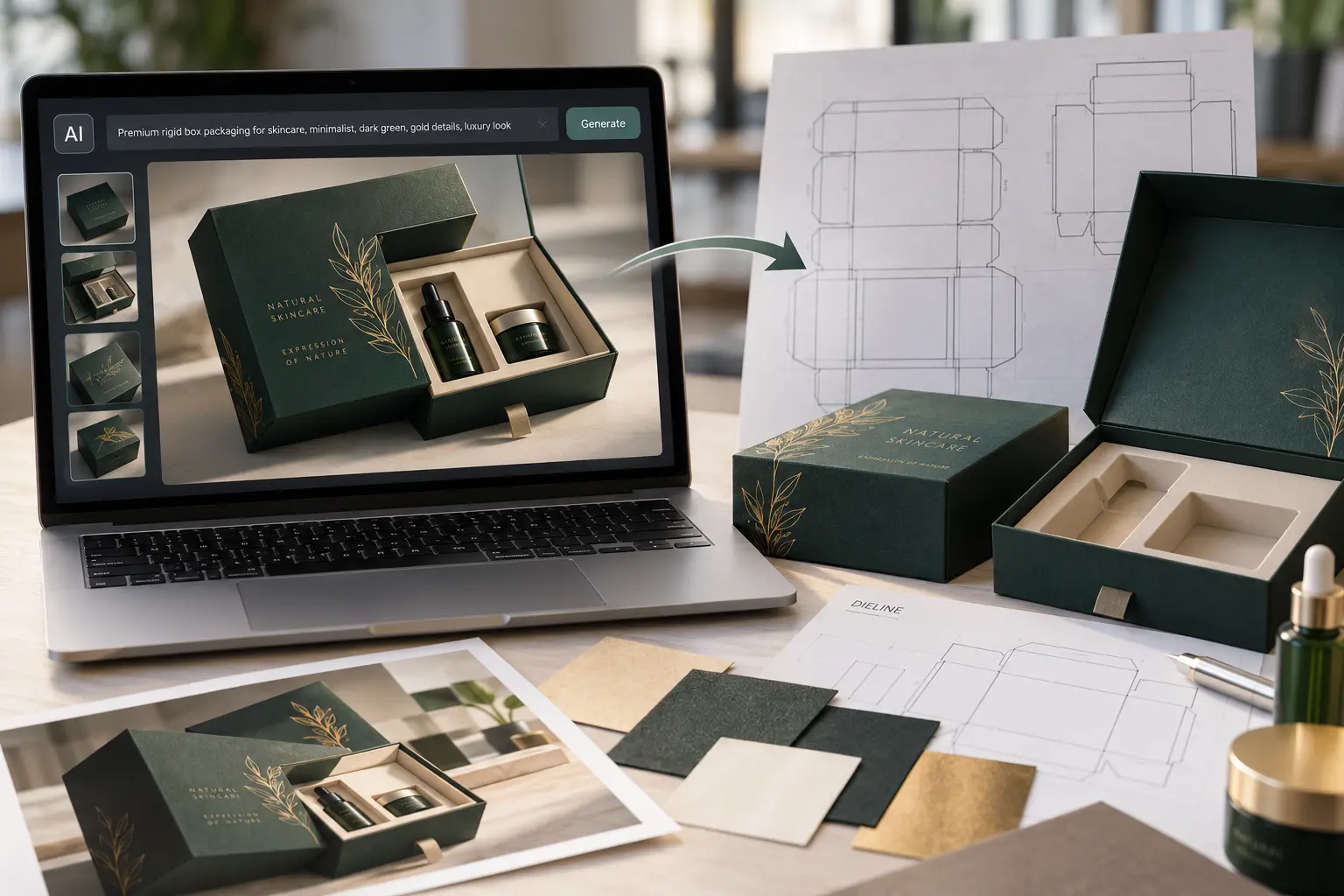
This mirrors how DST-Pack already approaches custom rigid boxes and modular advent-style packaging for other niche gifting occasions: small-batch, personalized, and built around a fixed date rather than a retail season. The same drawer-box and compartment tooling used for a 12-day beauty or hobby countdown adapts directly to a 7- or 12-day bridal version — the difference is mostly in finishing (metallics, ribbon pulls, wedding-appropriate colorways) rather than structure.
Common Formats and Sizing
Most wedding advent calendars fall into one of three structural formats, each with different production implications:
- Drawer-style boxes — a single rigid outer sleeve with individually numbered pull-out drawers. The most premium-looking option and the best fit for small, flat items (jewelry, notes, tea bags), but the most tooling-intensive to produce.
- Flip-lid compartment trays — one rigid base divided into fixed compartments, each with its own hinged or magnetic lid. Faster to produce than drawers and easier to personalize per-compartment (numbers, initials, icons).
- Nested boxes or envelopes in a single container — the simplest format, essentially a curated set of small boxes or envelopes packed into one outer box or basket. Lowest tooling cost, fastest turnaround, and the easiest starting point for a brand testing the category before committing to a dedicated structure.
Day counts also vary by intent: 7 days is common for a bridal-party gift assembled quickly before a shower, 12 days mirrors the classic advent format and gives more room for a narrative arc (practical gifts early, sentimental ones closer to the wedding), and 14 days or more starts to resemble a full pre-wedding gifting program rather than a single gift.
Entry Points for a Brand or Retailer
For a brand or retailer weighing whether to enter the category, there are a few practical entry points:
- A single pre-curated SKU — one fixed 7- or 12-day box sold as-is, the lowest-complexity way to enter the category
- A customizable base structure — one tooled box design offered with swappable colorways, foil names, and compartment counts, so a single mold or die serves many personalized orders
- A private-label option for wedding planners and bridal boutiques — supplying the empty structure for a planner or boutique to fill and resell under their own branding
Each option shifts the manufacturing requirement differently: a single SKU needs one efficient run, while a customizable base needs a structure that tolerates variation in finishing without new tooling for every order.
The Takeaway
The wedding advent calendar isn’t a separate product category so much as proof that the countdown-box format keeps finding new occasions. It’s currently driven by individuals and small gifting brands rather than major retailers, which means the opportunity sits with manufacturers who can do short runs, fast turnarounds, and real personalization — not the volume players built for a single December peak.
Ready to Develop a Wedding Advent Calendar Line?
Whether you need a single pre-curated design, a customizable structure for made-to-order sales, or a private-label option for wedding planners and boutiques, DST-Pack can develop the rigid box, compartment, or drawer structure to match. Get in touch with our team to discuss materials, minimum order quantities, and turnaround times for your first run.