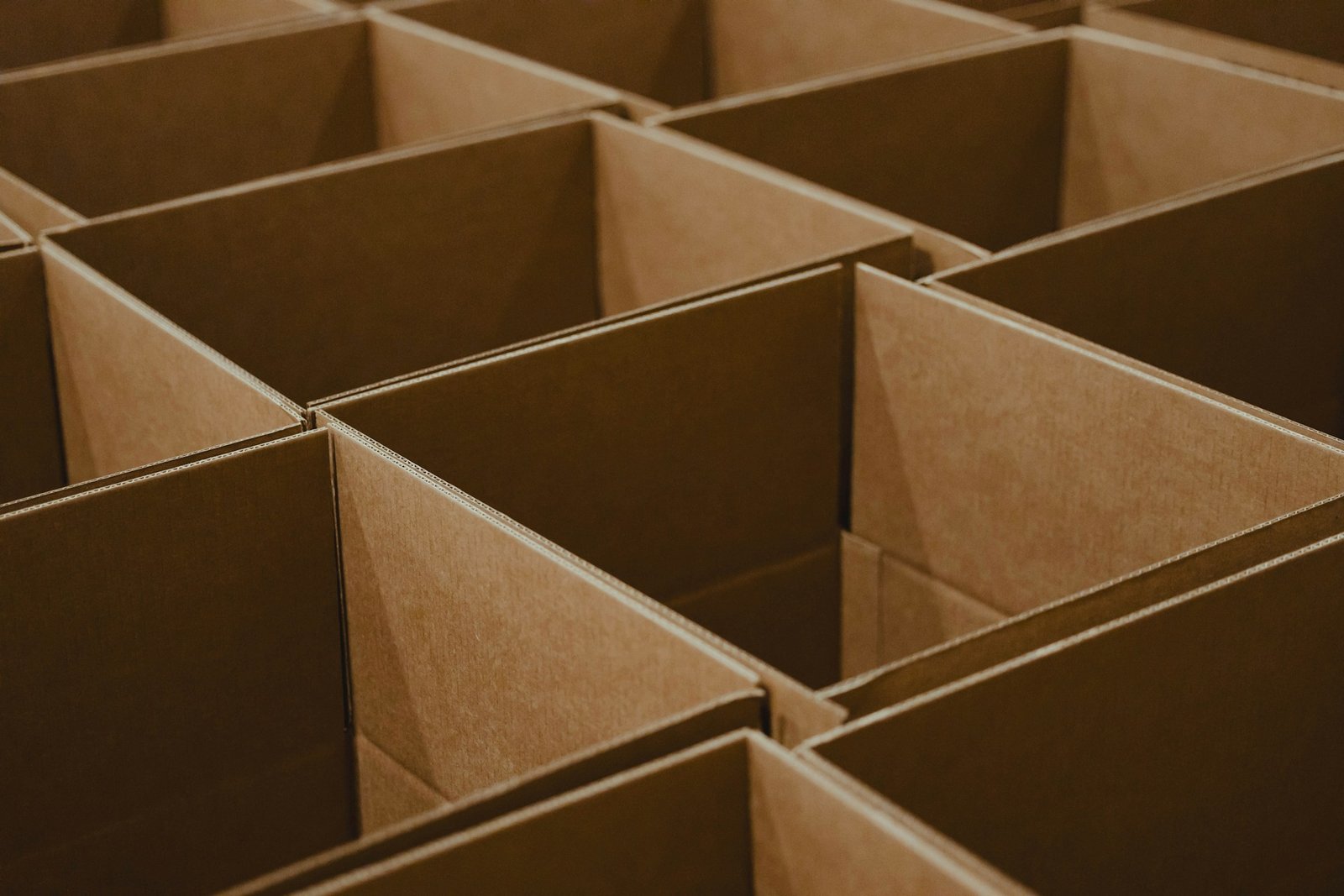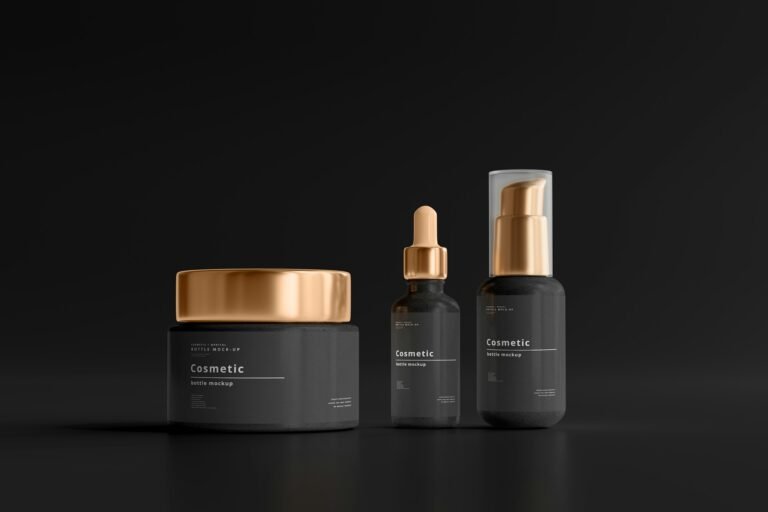
Open almost any premium skincare gift set from the last fifteen years and you’ll find the same construction: a paper-based outer box holding a precisely thermoformed plastic or EVA foam tray, cut to the exact silhouette of each bottle, jar, and applicator inside. It works extremely well — that’s exactly why it became the default. The plastic insert holds its shape under pressure, resists moisture from oils and creams, and can be tooled to a tolerance of a millimeter or two around a curved glass bottle. The problem is what happens to that construction at end of life: a paper box with a plastic insert is a mixed-material assembly, and mixed-material assemblies are becoming a genuine liability under the recyclability rules now reshaping European and, increasingly, US packaging design.
That’s the real question behind “plastic vs. molded fiber” for a cosmetics brand right now. It isn’t really about sustainability marketing — it’s about whether a mono-material fiber insert can actually do the protective job a thermoformed plastic tray has been doing for decades, without the brand having to accept a downgrade in how the product looks and feels inside the box.
Why “mono-material” specifically matters now
The EU’s Packaging and Packaging Waste Regulation (PPWR) pushes hard toward packaging that can be sorted and recycled as a single material stream. A rigid paperboard box is straightforward to recycle on its own. A rigid paperboard box with a bonded or loosely fitted plastic thermoformed tray inside is not — recycling facilities sorting fiber streams generally aren’t equipped to separate out a plastic insert automatically, which means the whole assembly is at real risk of being treated as contaminated fiber or simply landfilled rather than recycled as either material.
This is why “mono-material” has become the specific design target, rather than just “more sustainable” in a general sense. A box and insert made entirely from paper-based fiber can go through a single recycling stream cleanly. A box and insert made from two different materials, however well-intentioned each individually, usually can’t — even if both the box and the plastic insert would technically be recyclable on their own.
What plastic and EVA foam actually solved
It’s worth being honest about why thermoformed plastic and EVA foam became standard in the first place, because any real material comparison has to measure against what they actually do well:
- Precision fit. Thermoforming molds to an exact product silhouette, which matters enormously for glass bottles and delicate applicators that need to sit without shifting during transit.
- Moisture and oil resistance. Cosmetic products — creams, oils, serums — are exactly the kind of contents that can degrade uncoated fiber over time if a container leaks even slightly.
- Consistent cushioning. EVA foam in particular compresses and rebounds predictably, absorbing repeated impact without permanently deforming, which matters across a long shipping and handling chain.
- A clean, uniform surface finish, which for premium packaging is as much about how the product looks nestled in its cavity as it is about function.
Any fiber-based alternative has to be judged against this specific bar, not against a generic idea of “good enough” protection.
What modern molded fiber actually delivers
Molded fiber has changed considerably from the rough, visibly textured pulp associated with egg cartons and older produce trays. There are two distinct production methods worth understanding, because they perform very differently:
Wet-pressed molded fiber is the more common, lower-cost process — fiber slurry is pressed into a mold and dried, producing a slightly textured, matte surface. It’s fully compostable and gives a natural, tactile look that some premium brands actively want as part of the aesthetic, but it has more limited dimensional precision than thermoformed plastic.
Dry-pressed (thermoformed) molded fiber uses heat and pressure to cure the fiber inside the mold, producing a smoother, higher-precision surface that’s much closer to what a plastic tray delivers — brands and packaging engineers increasingly describe well-executed dry-pressed fiber trays as offering “glove-like” protection comparable to EVA foam or vacuum-formed plastic, while remaining a single recyclable, compostable material.
On pure protective performance, the honest answer is that dry-pressed molded fiber has closed most of the gap with plastic and foam for the majority of cosmetics packaging use cases — it absorbs impact energy through the structure of the material itself rather than relying on the rebound elasticity foam does, and it can be engineered to hold precise cavity shapes for bottles and jars. Where a real gap can remain is on extremely heavy glass components, unusually complex geometries, or applications where a completely uncoated fiber surface would sit in direct, sustained contact with an oil-based product — situations where a light, food-safe barrier coating or a hybrid approach may still be the more realistic answer than a fully uncoated fiber tray.
Where the honest trade-offs still are
A fair comparison shouldn’t oversell fiber as a drop-in replacement in every situation. A few places where the trade-off is real, not just a perception problem:
Color and finish matching. Thermoformed plastic can be produced in an exact, consistent brand color at scale with relative ease. Molded fiber can be color-matched too, but achieving the same flat, uniform finish — particularly in darker or more saturated brand colors — is a more involved process, and it’s worth sampling before committing to a full production run.
Tooling lead time for complex cavities. Both plastic thermoforming and dry-pressed fiber require custom mold tooling, and neither is instant — but very intricate, multi-cavity geometries can take longer to get right in fiber, simply because the material behaves differently during pressing than plastic does during vacuum forming.
Moisture-sensitive direct contact. As noted above, an uncoated fiber surface in prolonged direct contact with an oil-based product is a real consideration, not a hypothetical one — this is a genuine engineering question to work through with a packaging partner rather than something to assume away.
None of these are reasons to default back to plastic. They’re reasons to treat the insert as its own design and testing process, the same way the box and print finish already get one.
What this means for a cosmetics packaging decision right now
For most gift sets, skincare bundles, and single-product luxury cosmetics packaging, a well-engineered dry-pressed molded fiber insert is now a realistic, protection-equivalent alternative to a thermoformed plastic tray — and it solves the mono-material recyclability problem that plastic-and-paper assemblies increasingly can’t. For a smaller number of genuinely demanding applications — very heavy glass, unusually complex multi-product cavities, sustained direct oil contact — the right answer may still involve a coated fiber solution or a case-by-case engineering conversation, rather than a blanket material swap.
The practical starting point is the same either way: test the actual insert against the actual product, at the actual weight and shipping conditions it will face, before locking a full production run. That’s a sampling and engineering process, not a marketing decision.
Weighing a mono-material insert redesign for your next cosmetics packaging run? Let’s work through the structure and get you real numbers.