written by DST-Pack director Stanislav Krykun
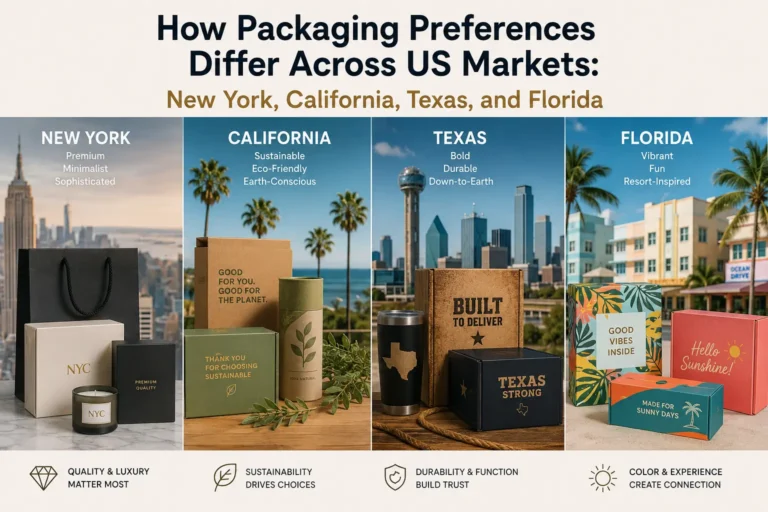
The United States is not one packaging market. It is four or five distinct markets that happen to share a currency and a postal service. A brand manager in Austin buys packaging differently than one in Manhattan. A cosmetics founder in Los Angeles has different expectations, priorities, and regulatory pressures than a hospitality buyer in Miami. A corporate gifting manager in Houston is solving different problems than her counterpart in San Francisco.
These differences are real, consistent, and commercially significant. They reflect the industries concentrated in each region, the cultural expectations of consumers in each market, the regulatory environment brands operate in, and the distribution channels they sell through. For a packaging supplier — and for brands choosing one — understanding them matters.
This article draws on DST-Pack’s experience working with US brands across these four states, alongside publicly available market data and regulatory information, to map what actually differs in packaging preferences from region to region.
Why Regional Differences in Packaging Exist
Before going state by state, it is worth understanding why regional differences exist at all. Packaging preferences are not arbitrary — they are downstream effects of three things:
Industry concentration. The types of businesses concentrated in a region determine what packaging is being bought. Silicon Valley has thousands of technology companies with large gifting budgets and specific expectations about presentation. The Houston energy corridor has oil and gas companies with different gifting cultures. Napa Valley has wine producers with a centuries-old tradition of premium presentation. The product determines the package, and the product is determined by the local economy.
Consumer expectations. Consumer attitudes toward sustainability, luxury, minimalism, or bold visual identity vary meaningfully by region. California consumers — particularly in Los Angeles and the Bay Area — have some of the highest expectations for sustainability credentials in packaging of any market in the world. New York consumers in luxury retail contexts have some of the highest expectations for visual sophistication. These expectations filter up through the brands serving those consumers and into their packaging decisions.
Regulation. California’s packaging regulations are among the strictest in the world and are now actively shaping what materials brands can use. New York has its own extended producer responsibility legislation. These regulatory realities create genuine differences in what packaging is specified in those markets versus states with lighter regulatory frameworks.
New York: Luxury, Finance, Fashion, and the Primacy of Visual Presentation
New York City is the US capital of visual culture. Fashion, finance, luxury retail, media, and hospitality — the industries that define New York — all share a common characteristic: they compete intensely on how things look. That competitive visual intensity shapes packaging decisions in ways that are distinctly New York.
What New York brands prioritize:
The dominant packaging request from New York brands — particularly in Manhattan, Brooklyn’s premium retail scene, and the broader tri-state luxury market — is visual sophistication at a level that competes with the European luxury houses that New York consumers routinely compare against. Soft-touch matte laminate as a base, with gold or silver foil stamping, spot UV, or embossing as accent treatments, is the most common specification. The finish quality matters as much as the structure — a box that looks premium in a photograph but reveals mediocre material quality in person fails the New York market.
In 2024, the corporate sector saw luxury packaging for business gifts rise by 27%, with premium alcohol, jewelry, and skincare categories leading demand. New York accounts for a disproportionate share of this demand — the density of financial services firms, law firms, management consultancies, and luxury brands in Manhattan creates one of the highest-value corporate gifting markets in the country.
Key industries driving packaging demand in New York:
Financial services and professional firms. Wall Street, Midtown law firms, and management consultancies gift heavily at Christmas and for client relationship management. The packaging brief from this sector is consistent: the box needs to look like it belongs in a boardroom. Rigid magnetic closure boxes in dark navy, black, or deep burgundy, with restrained gold foil branding, dominate. The quantity is typically smaller — 50 to 200 units — but the per-unit quality expectation is very high.
Fashion and luxury retail. New York’s fashion industry — concentrated in the Garment District, with showrooms and flagship stores throughout Manhattan — uses packaging as an extension of brand identity in ways that are more sophisticated than most other US markets. Fashion brands in New York frequently request custom structural design rather than adapted standard formats, and surface finishing expectations are extremely high.
Food and hospitality. New York’s premium food scene — from Chelsea Market artisans to Brooklyn’s specialty food producers — uses packaging that positions products directly against European imports. This means the quality bar is set by Parisian chocolatiers and Italian food producers, not by domestic competitors. The ask is almost always rigid construction, premium finish, and small quantities.
What makes New York different from other markets:
New York buyers are among the most specification-literate packaging buyers in the US. They know what soft-touch laminate feels like, they know the difference between a 1,800gsm and a 2,400gsm rigid box, and they will notice immediately if a production run does not match the approved sample. The inspection rigour in New York is higher than in most other US markets, which means the sample approval process matters more and production consistency is non-negotiable.
California: Sustainability First, Design Second, Scale Third
California is the largest state economy in the US and the most complex packaging market. The regulatory environment alone makes it distinct — but regulation is only part of the story. California’s packaging preferences are also shaped by a design culture that values restraint and intentionality over ornamentation, and by a consumer base that genuinely investigates the sustainability claims on packaging.
What California brands prioritize:
Sustainability credentials are the first filter in California packaging decisions in a way they are not in any other US state. This is partly driven by consumer expectation and partly by regulatory reality.
California’s Senate Bill 54 requires companies that sell or distribute single-use packaging or food-service ware in California to take responsibility for the end-of-life of their product packaging, with 100% of covered packaging required to be recyclable or compostable by 2032. A material is only recyclable in California if CalRecycle confirms infrastructure exists to collect, sort, and reprocess it for at least 60% of Californians — the number in a chasing arrows triangle is not sufficient.
For brands selling into the California market, this means that packaging material choice is now a compliance question as much as an aesthetic one. Paper-based rigid box packaging — inherently recyclable through California’s curbside infrastructure — is well-positioned in this regulatory context. Brands in California frequently request FSC-certified materials and ask for material documentation they can use in their own sustainability reporting.
Beyond regulation, California’s design culture favors clean minimalism over elaborate ornamentation. The visual language of premium packaging in Los Angeles and San Francisco leans toward: one or two colors, generous negative space, restrained typography, matte finishes rather than gloss, and natural tones. This is different from New York, where a more maximalist luxury aesthetic is acceptable, or Texas, where bold branding is common.
Key industries driving packaging demand in California:
Cosmetics and beauty. Los Angeles is the US capital of independent beauty. The density of indie skincare, cosmetics, and wellness brands — many of them DTC, selling through Sephora, Erewhon, or their own channels — creates enormous demand for premium cosmetic packaging that meets sustainability standards without compromising visual quality. The brief from this sector almost always includes: clean design, matte finish, sustainable materials, small quantities to start, physical sample before commitment.
Wine. California produces 85% of US wine output. The Napa Valley, Sonoma County, Paso Robles, and Santa Barbara County wine regions collectively represent one of the world’s premium wine markets. Wine estates and wine clubs need packaging that justifies price points of $30 to $200+ per bottle — gift sets, two-bottle boxes, seasonal collections. The aesthetic here is more heritage-influenced than the tech sector, but the sustainability requirement remains consistent.
Technology corporate gifting. Silicon Valley and the broader Bay Area technology sector generates some of the largest corporate gifting budgets in the US. By 2025, nearly 34% of corporate gifts included custom branding or packaging. Bay Area technology companies are particularly sophisticated in their gifting programs — onboarding kits, client appreciation programs, and conference giveaways where the packaging is explicitly part of the brand experience. The design expectation from this sector is clean and modern rather than traditionally luxurious.
Wellness and natural food. California’s wellness market — supplements, adaptogens, CBD, organic food, specialty nutrition — is the largest in the US. Packaging in this sector must communicate both premium quality and natural/sustainable credentials simultaneously, which is a specific brief that favors paper-based construction with FSC certification and muted, natural color palettes.
What makes California different from other markets:
California brands ask more questions about materials than buyers anywhere else in the US. They want to know what the board is made of, whether it is FSC-certified, what the laminate composition is, and whether the finished box is kerbside recyclable in California. This is not bureaucratic — it is because their retail buyers, their end consumers, and now their regulators are asking the same questions of them. Packaging suppliers who cannot provide material documentation lose California accounts.
Texas: Scale, Corporate Identity, and the Value of Bold Branding
Texas is the second-largest US economy and the fastest-growing major state by business formation. The packaging preferences of Texas brands reflect a business culture that values scale, directness, and unmistakable brand identity — and an industry mix that is unlike any other state.
What Texas brands prioritize:
Texas buyers are less focused on minimalist design than their California counterparts and less preoccupied with European luxury aesthetics than New York buyers. The dominant priorities in Texas packaging are brand visibility, structural reliability, and value at scale. A Texas corporate gifting buyer ordering 500 branded boxes for a client appreciation event wants those boxes to unmistakably represent the company — logo prominently placed, brand colors accurately reproduced, quality that reads as premium without being ostentatious.
The corporate gifting market in Texas is large and growing rapidly. More than 68% of companies increased their gifting budgets in 2024. In Texas, this growth is concentrated in the energy sector, real estate, healthcare, and the state’s fast-expanding technology corridor in Austin. Each of these sectors has a distinct gifting culture, but they share a common preference for packaging that is well-made, clearly branded, and delivered reliably.
Key industries driving packaging demand in Texas:
Energy sector corporate gifting. The Houston energy corridor — home to more Fortune 500 companies than any US city outside New York — generates consistent demand for high-quality corporate gift packaging at meaningful volume. Oil and gas companies, energy services firms, and the broader petrochemical sector gift heavily at Christmas and for major deal closings. The expectation is premium quality without the maximalist luxury aesthetic of New York — practical elegance rather than conspicuous luxury.
Real estate. Texas real estate — particularly in Dallas-Fort Worth, Houston, and Austin — is one of the most active residential and commercial markets in the US. Real estate agents in Texas use branded gift packaging heavily for closing gifts, which is an established cultural practice in this market. The packaging brief from real estate buyers is specific: branded box that looks premium, appropriate for a family home closing gift, delivered quickly, and reorderable without a lengthy briefing process each time.
Austin technology. Austin has emerged as a significant technology hub, particularly post-2020, with major relocations from Silicon Valley. The Austin technology sector has packaging preferences that blend California’s sustainability consciousness with Texas’s directness — sustainable materials, clean design, but with bolder branding than the Bay Area aesthetic.
Food and beverage. Texas has a strong craft food and beverage scene — craft beer, BBQ sauce and rubs, hot sauce, specialty meats, artisan confectionery — with brands that use packaging to access premium retail and gifting channels. The aesthetic here is often more boldly Texan than minimalist, with stronger color use and more prominent brand identification.
What makes Texas different from other markets:
Texas buyers are more comfortable with larger initial quantities than California or New York buyers at the same brand scale. The business culture is oriented toward decisive action and scale rather than gradual testing. This means Texas orders often skip the single-sample test run and move directly to production after sample approval. The relationship dynamic is also important — Texas buyers value long-term supplier relationships and reliable reorder processes over the flexibility of switching suppliers frequently.
Florida: Hospitality, Tourism, Luxury Retail, and the Latin American Gateway
Florida is a more complex packaging market than it is often given credit for. The state’s economy is built on hospitality, tourism, real estate, and healthcare — industries that use packaging in distinct ways — and Miami specifically has become the US gateway to Latin American luxury markets, which adds an international dimension to Florida packaging preferences.
What Florida brands prioritize:
Florida packaging preferences sit somewhere between New York’s luxury orientation and California’s sustainability consciousness, with a hospitality industry influence that is unique to the state. The dominant brief from Florida brands is premium presentation that photographs well, works across multiple use cases (retail, gifting, hospitality amenities), and is produced at moderate quantities with fast turnaround for the seasonal nature of the Florida market.
Miami’s luxury retail and hospitality scene — particularly in Miami Beach, Brickell, and the Design District — has genuine luxury expectations comparable to Manhattan, but with a visual aesthetic that is warmer and more expressive than New York’s restrained European influence. Color is used more boldly in Miami packaging than in New York; the influence of Latin American design culture is visible in the premium retail packaging of Miami brands.
Key industries driving packaging demand in Florida:
Hospitality and hotel amenities. Florida’s hotel industry — from the luxury resorts of Miami Beach to the major theme park hotels of Orlando to the boutique properties of Palm Beach — uses custom packaging for in-room amenities, spa products, F&B gifting, and event activations at significant scale. Hotel packaging in Florida needs to communicate the property’s brand positioning — which varies enormously from a Disney resort to a boutique South Beach hotel — while being produced at quantities that match occupancy cycles.
Real estate. Miami and South Florida’s high-end real estate market — particularly condo pre-sales and luxury residential closings — uses premium packaging for client gifts and marketing materials in ways that mirror the Texas real estate market but with a more explicitly luxury aesthetic. The price points in South Florida real estate are higher, and the packaging is expected to reflect that.
Tourism and specialty retail. Florida’s tourism industry creates consistent demand for premium gift packaging — artisan food, spirits, specialty products presented in branded boxes that serve as both product presentation and souvenirs. The Key West rum distillery packaging brief is different from the Napa winery brief, but both require premium rigid box construction with distinctive visual identity.
Latin American export market. Miami’s position as the gateway to Latin America means that Florida brands selling into that market have packaging requirements shaped by Latin American luxury expectations — which skew toward more elaborate presentation, richer color use, and more prominent brand identity than the US domestic premium market. Brands in Miami packaging for this market often request different specifications than their domestic US packaging.
What makes Florida different from other markets:
Florida’s hospitality industry creates a reorder pattern that other markets do not. A Miami Beach hotel that uses custom branded packaging for its spa gift sets needs to reorder consistently through the year as inventory turns over. This creates a supplier relationship dynamic where consistency across reorders — same finish quality, same board weight, same print accuracy — matters more than flexibility. Florida buyers also deal with a climate that affects packaging: high humidity in summer months means that packaging stored in non-climate-controlled environments needs to be specified accordingly, which occasionally affects material choice.
Cross-Market Observations: What the Differences Tell Us
Looking across these four markets, several patterns emerge that are worth naming explicitly.
Sustainability is a spectrum, not a binary. California has the most rigorous sustainability requirements and the most sophisticated buyers on this dimension. New York buyers have high sustainability awareness but it is a secondary priority to visual quality. Texas buyers are increasingly sustainability-conscious but the market lags California by several years. Florida buyers are beginning to ask sustainability questions, particularly in the hospitality sector under pressure from international luxury chains with published ESG commitments. Understanding where a buyer sits on this spectrum matters for what documentation and material specifications to lead with.
The brand identity expectation varies with visual culture. New York and Miami buyers have the strongest visual sophistication — they are surrounded by world-class brand design and measure packaging against it. California buyers increasingly value restraint and intentionality over elaboration. Texas buyers value clarity and scale. These are generalizations with significant variation within each state, but they provide a useful starting framework.
Quantity at first order reflects business culture. California and New York brands are more likely to start with 100 to 200 unit test runs. Texas brands are more likely to commit to 500 to 1,000 units on the first order. Florida brands vary by sector — hospitality buyers often order larger quantities for operational needs, while retail brands are more cautious.
Regulatory awareness correlates with compliance burden. California buyers ask more questions about materials because California has more material regulations. As other states — including New York — develop their own extended producer responsibility frameworks, buyers in those markets will develop similar sophistication. Packaging suppliers who can provide material documentation proactively will have a competitive advantage as regulation expands nationally.
Working With US Brands Across All Four Markets
DST-Pack produces custom packaging for brands in New York, California, Texas, and Florida. Our experience across these markets informs how we approach each brief — asking the right questions about industry, channel, sustainability requirements, and visual expectations before making structural or material recommendations.
Whether you are a Los Angeles cosmetics brand with sustainability compliance questions, a Houston energy company ordering corporate gifts at scale, a Manhattan luxury food producer with high finish expectations, or a Miami hotel sourcing branded amenity packaging — the brief starts the same way: a conversation about what the box needs to do and who it needs to do it for.
Sources referenced:
- California SB 54 — Plastic Pollution Prevention and Packaging Producer Responsibility Act, CalRecycle
- Paramount Global — California SB 54 Explained
- EcoPackables — Guide to California SB 54
- Market Reports World — Luxury Gift Packaging Market 2024
- Straits Research — Luxury Packaging Market
- EVERKI — Corporate Gifting Statistics 2024–2025
- Teak & Twine — Trending Corporate Gifts 2025