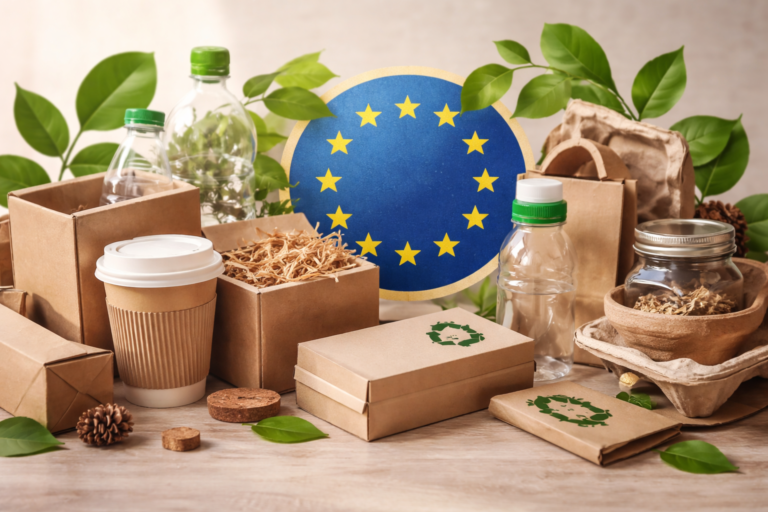
If you sell products in Europe, there’s a date you shouldn’t ignore: August 12, 2026.
That’s when the new EU Packaging and Packaging Waste Regulation (PPWR) fully kicks in. And despite how technical the name sounds, the impact is very real — it will affect how your packaging looks, how much it costs you, and in some cases whether you can even sell your product in the EU at all.
A lot of companies still treat this as “something environmental for later”. That’s a mistake. The changes are already in motion, and by the time 2026 arrives, it will be too late to react quickly without paying for it.
Let’s break this down in a practical way — what’s actually changing, what it means in real business terms, and what you should start doing now.
First, what is PPWR really?
In simple terms, PPWR is the EU saying: “We want less packaging waste, and we want all packaging to be easier to recycle or reuse.”
That doesn’t sound new. But what is new is how strict and unified this regulation is.
Before, there was a directive. Each country interpreted it differently. Germany had one system, France another, Poland another. You could adjust slightly market by market.
Now? One regulation. Same rules everywhere in the EU.
So instead of adapting per country, you either comply — or you don’t enter the market.
Why this is a bigger deal than it seems
On paper, PPWR is about sustainability. In reality, it’s about control over packaging standards at scale.
It affects:
- what materials you can use
- how big your packaging is
- how “complicated” it can be
- how it gets recycled
- and who pays for that recycling
For some companies, this will mean small adjustments. For others, it’s a complete redesign of their packaging line.
And here’s the important part: packaging changes are never instant. Tooling, sourcing, testing, logistics — it all takes time.
The biggest shift: packaging must actually be recyclable
This is where many brands will run into problems.
A lot of packaging today is technically recyclable, but not in reality. Multi-layer materials, mixed plastics, decorative elements — they look good, but they’re difficult to process.
PPWR is pushing toward something much stricter: packaging that works in real recycling systems, not just in theory.
So what starts disappearing?
- multi-material laminates
- complex plastic combinations
- anything that can’t be easily sorted
If your packaging relies on that “premium feel” created by mixing materials, you’ll probably need to rethink it.
Oversized boxes are becoming a liability
If you run an e-commerce brand, this part matters a lot.
The EU is actively targeting empty space in packaging. You know the situation — a small product inside a big box filled with paper or air pillows.
That’s no longer just inefficient. It will be considered excessive.
Companies will be expected to:
- reduce box sizes
- fit packaging closer to product dimensions
- avoid unnecessary layers
This sounds simple, but in practice it means reworking packaging formats, especially if you rely on standard box sizes for convenience.
Reuse is no longer optional (in some cases)
Another shift that’s coming gradually but steadily: reuse systems.
Not everywhere, not for everything — but in certain sectors, single-use packaging will start losing ground.
Transport packaging, shipping systems, even some retail formats will be pushed toward:
- returnable packaging
- refill models
- longer-lasting materials
This isn’t something most businesses are used to thinking about. It’s a different mindset — packaging is no longer “used once and forgotten”.
Recycled materials: demand goes up, so do expectations
Plastic packaging will need to include recycled content.
Sounds reasonable — but here’s where it gets tricky.
High-quality recycled material is still limited. And when demand increases across the entire EU, prices tend to follow.
So companies will face a combination of:
- higher material costs (at least initially)
- stricter documentation requirements
- pressure to prove what’s inside their packaging
If your supply chain isn’t transparent today, it will need to be.
Some materials will simply disappear
One of the clearer changes: restrictions on certain chemicals, including PFAS.
These are widely used in packaging that needs to resist grease, moisture, or heat — especially in food-related products.
The problem is, they don’t break down easily. That’s why they’re being phased out.
For businesses, this means:
- reformulating materials
- testing alternatives
- sometimes accepting trade-offs in performance or cost
Labeling will become more standardized
Right now, packaging labels can be confusing. Different symbols, different rules depending on the country.
PPWR is trying to fix that by introducing more consistent labeling.
You’ll need to clearly show:
- what the packaging is made of
- how to dispose of it
- sometimes additional data via QR codes
This isn’t the most complex part of the regulation, but it adds another layer of compliance that needs to be managed.
You pay for your packaging — even after it’s thrown away
This is where costs can quietly increase.
Under Extended Producer Responsibility (EPR), companies are financially responsible for what happens to their packaging after use.
That includes:
- collection
- recycling
- waste management
And here’s the catch: the less recyclable your packaging is, the more you’ll likely pay.
So packaging decisions are no longer just about production cost. They affect long-term operational costs too.
Different industries, different pressure points
Not every business will feel PPWR in the same way.
E-commerce will struggle most with packaging size and efficiency.
Cosmetics will need to rethink decorative packaging that mixes materials.
Food brands will deal with chemical restrictions and barrier materials.
Retail and FMCG will feel pressure around standardization and volume reduction.
But in all cases, the direction is the same: simpler, more recyclable, less waste.
The biggest mistake right now: doing nothing
A lot of companies are waiting.
Waiting for more clarity. Waiting to see what competitors do. Waiting until it becomes urgent.
The problem is, by the time it feels urgent, you’re already late.
Packaging changes involve:
- design
- sourcing
- prototyping
- testing
- production adjustments
That’s not something you fix in a month.
So what should you actually do now?
Nothing extreme. But definitely something.
Start with a simple audit:
- what materials are you using?
- can they be easily recycled?
- are you overpacking your product?
Then look at your suppliers:
- can they provide recycled materials?
- do they understand upcoming EU requirements?
And maybe most importantly — start thinking about packaging as a long-term system, not just a box.
There’s also an upside (if you move early)
It’s easy to look at PPWR as just another cost or restriction.
But there’s another angle.
Companies that adapt early can:
- reduce material usage (and save money)
- improve logistics efficiency
- position themselves as sustainable without greenwashing
- avoid last-minute compliance costs
In other words, this is one of those situations where doing things earlier is actually cheaper.
Where DST-Pack fits into this
This is exactly the kind of transition where having the right packaging partner matters.
At DST-Pack, we’re already working with clients who are adjusting their packaging ahead of 2026 — not just to “comply”, but to make smarter decisions overall.
That usually means:
- simplifying packaging structures
- finding cost-effective recyclable materials
- reducing size and shipping inefficiencies
- planning ahead instead of reacting later
Because in most cases, the goal isn’t just sustainability — it’s keeping packaging practical and cost-efficient under new rules.
Final thought
August 12, 2026 might feel far away.
But in packaging terms, it’s actually very close.
Because once the regulation is fully enforced, the companies that prepared early will move smoothly.
The rest will be rushing to catch up.