If you’ve ever ordered printed materials—catalogs, booklets, manuals, or even presentation decks—you’ve probably come across the term “collate” during the process. It sounds technical, but in reality, it refers to something quite straightforward that can make a big difference in how your printed materials are delivered.
Understanding what “collate” means is especially important if you’re working with multi-page documents or assembling printed packaging inserts. It affects not only the final result, but also efficiency, usability, and even cost.
Let’s go through it in a practical, no-nonsense way.
What Does “Collate” Mean?
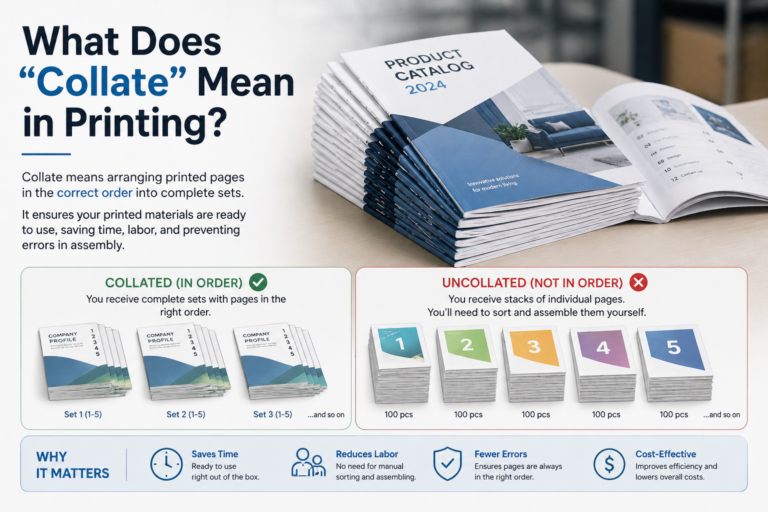
In printing, collate means arranging printed pages in the correct order into complete sets.
Imagine you’re printing a 10-page booklet and you need 100 copies.
If the pages are collated, you’ll receive complete sets where each booklet is already in order (1–10, 1–10, 1–10…).
If they are not collated, you’ll receive stacks of individual pages—100 copies of page 1, then 100 copies of page 2, and so on—leaving you to assemble them manually.
That’s the entire concept—but its impact is bigger than it seems.
Why Collation Matters More Than You Think
At first glance, collating might feel like a small detail. But if you’re dealing with real production—especially in packaging or large-scale printing—it quickly becomes critical.
When materials are properly collated, they arrive ready for use. This is essential for things like instruction manuals, product inserts, or marketing brochures that need to be included inside packaging.
Without collation, you’re adding an extra manual step. That means more labor, more time, and more room for mistakes.
For businesses scaling their operations, that’s not just inconvenient—it’s inefficient.
A Simple Real-World Example
Let’s say you’re producing a product that includes a folded instruction leaflet inside a box.
If your printer delivers collated sets, each leaflet is already complete and ready to insert.
If not, your team would need to gather each page, arrange them in the correct order, and assemble them manually.
Multiply that by hundreds or thousands of units, and the difference becomes obvious.
This is why companies working with suppliers like packaging manufacturer DST-Pack often coordinate both packaging and printed inserts together to ensure everything arrives production-ready.
Collated vs Uncollated: The Practical Difference
The difference isn’t about print quality—it’s about organization.
Collated printing is about delivering finished sets. It’s what you want when the pages belong together as a unit.
Uncollated printing, on the other hand, can make sense in specific situations. For example, if you’re printing single-page flyers or documents that don’t need to be grouped, uncollated output can actually be more efficient.
But for anything multi-page, collation is usually the smarter choice.
When You Should Always Choose Collation
There are certain cases where skipping collation simply doesn’t make sense.
If you’re printing booklets, catalogs, instruction manuals, product leaflets, training materials, or presentation decks, you almost always want them collated.
It ensures consistency and saves time at every stage after printing.
How Collation Fits Into Packaging Production
This is where things get more interesting.
In packaging, printing isn’t just about standalone materials—it’s part of a bigger system. You might have a box, an insert, a leaflet, and a warranty card that all need to come together smoothly during packing.
If printed materials are not collated correctly, it slows down the entire packing process. Workers have to stop, sort, and assemble instead of simply inserting and sealing.
That’s why experienced manufacturers don’t treat printing and packaging as separate processes. They look at how everything works together.
If you’re developing a custom packaging project, working with a team that understands both structure and print—like a packaging design service —helps avoid these operational bottlenecks early on.
Does Collation Affect Cost?
Yes—but not in the way most people expect.
Collating does add a small step during printing, which can slightly increase production cost. However, in most cases, it actually reduces overall costs because it eliminates manual labor later.
Think of it this way: you either pay a bit more upfront for automation—or you pay more later in time, labor, and potential errors.
For businesses producing at scale, collated printing is almost always the more economical option in the long run.
Digital vs Offset Printing and Collation
Modern printing technologies have made collation much easier.
With digital printing, collation is often automated by default. The machine prints and stacks pages in the correct order as part of the process.
Offset printing, which is more common for large volumes, may require an additional collation step depending on how the job is set up. But even there, it’s a standard part of professional print production.
In other words, collation isn’t a special request—it’s a normal part of doing things properly.
Common Mistakes to Avoid
One of the most common issues isn’t misunderstanding collation—it’s simply forgetting to specify it.
Many businesses assume that multi-page documents will automatically be delivered in order. That’s often true, but not always. And when it’s not, the consequences show up quickly during assembly.
Another mistake is not thinking about how printed materials will be used after production. Printing is just one step. What matters is how efficiently those materials integrate into your workflow.
The Bigger Picture: Printing as Part of the System
Collation is a small detail that reveals a bigger truth: printing should never be treated in isolation.
Whether you’re producing marketing materials or product packaging, everything is connected—from design to printing to final assembly.
That’s why businesses that scale successfully tend to work with partners who understand the full process, not just individual steps.
A well-organized print job doesn’t just look good—it works better.
Final Thoughts
“Collate” might sound like a technical term, but it simply means putting things in the right order.
And in printing, that order matters.
Choosing collated printing ensures your materials arrive ready to use, reduces manual work, and helps your operations run smoothly—especially when printing is part of a larger packaging process.
It’s one of those small decisions that quietly saves time, money, and frustration.
And when you’re dealing with production at scale, those are exactly the details that make the difference.