Hanukkah has become one of the fastest-growing seasonal packaging categories in North America and Europe, and the brands that win shelf space aren’t the ones with the lowest unit price — they’re the ones whose boxes look like a gift the moment a shopper picks them up. For retailers, kosher food brands, and Judaica companies, that means moving away from generic holiday tins and stock cellophane bags toward structural packaging built specifically around the symbols of the holiday: the menorah, the dreidel, the Star of David, and the eight nights themselves.
This guide covers what buyers actually need to know before placing a Hanukkah packaging order: box formats that work for gelt and small gifts, magnetic closure options, kosher-compliant material and printing considerations, MOQs, and realistic lead times for a holiday with a hard, immovable ship date.
Why Hanukkah Packaging Is a Distinct Category
Hanukkah packaging sits in an unusual spot in the seasonal calendar. It shares shelf space with general winter holiday packaging but has to visually and culturally stand apart from Christmas-coded reds, greens, and Santa iconography. Retailers buying for Judaica sections, kosher grocery chains, and gift boutiques are specifically looking for:
- Blue, white, silver, and gold color palettes instead of traditional Christmas colors
- Star of David, dreidel, menorah, and Hebrew lettering as structural or print motifs
- Packaging sized for gelt (chocolate coins), small Judaica gifts, and 8-night countdown formats
- Kosher-appropriate material sourcing where food contact is involved
Because Hanukkah’s date shifts on the Gregorian calendar and the shopping window is short (typically a 4–6 week sell-through), buyers who order generic “winter holiday” stock packaging often end up with boxes that read as Christmas-adjacent rather than purpose-built. Custom tooling solves that mismatch — and once a die-line exists, it’s reusable every year with only graphic and print changes, which lowers cost significantly from year two onward.
Magnetic Gift Boxes: The Premium Standard for Judaica and Gifting
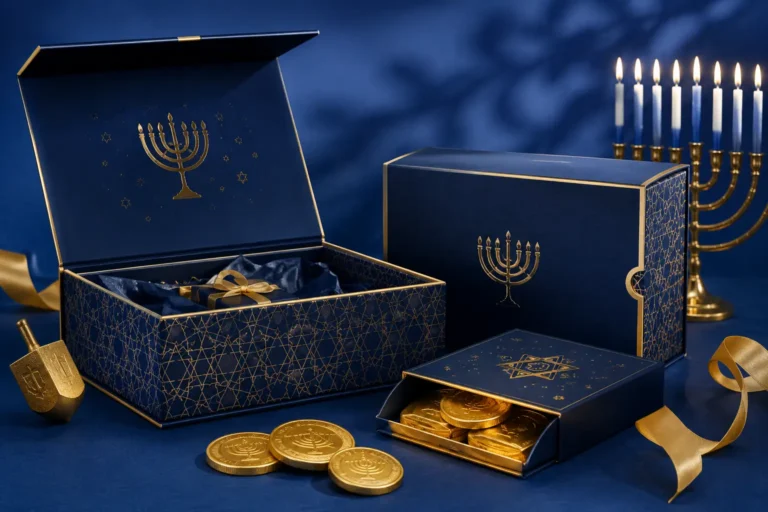
Magnetic closure rigid boxes have become the default premium format for Hanukkah gifting, for the same reason they dominate cosmetics and luxury gifting year-round: the closure feels expensive without adding assembly complexity for the end customer.
Common Hanukkah magnetic box applications:
- Menorah and candle gift sets
- Curated Judaica gift boxes (dreidel, gelt, candles, book)
- Corporate/client Hanukkah gifting programs
- Premium gelt boxes for kosher confectioners
- Retailer-branded 8-night gift sets
Structural options buyers typically choose between:
| Format | Best For | Notes |
|---|---|---|
| Two-piece magnetic rigid box | Menorahs, curated gift sets | Strongest shelf presence, higher unit cost |
| Book-style magnetic box | Flat gifts, gift cards, jewelry-adjacent Judaica | Opens like a book, strong print real estate on the inner face |
| Drawer-style magnetic box | Gelt, small candles, dreidels | Sleeve slides out of a rigid outer shell, tactile unboxing |
| Foldable magnetic box | Retailers needing flat-pack shipping economics | Ships flat, assembles on arrival, lower freight cost than rigid |
Foil stamping (gold and silver are by far the most requested finishes for this category) and spot UV on a Star of David or menorah motif are the two upgrades that consistently perform best in buyer testing, because they read as premium under both daylight and the low warm lighting typical of holiday retail displays.
Gelt Cartons: Solving the Small-Format, High-Volume Problem
Gelt packaging is a different design problem entirely. Chocolate gelt is typically sold in high unit volumes at a low price point, which means the carton needs to be cheap to produce at scale, food-safe, and fast to fill on a co-packing or hand-fill line — while still looking distinct enough to stand out in a bin display or endcap.
Formats we produce most often for gelt and small Hanukkah confectionery:
- Mesh or net gelt bags in printed header cards — low cost, works well for bulk bin displays
- Small rigid or folding cartons shaped like a dreidel or Star of David — higher perceived value, works well for gifting-tier gelt
- Coin-roll style tubes — mimics the look of a literal coin roll, strong novelty appeal
- Multi-compartment trays inside an outer sleeve — used for assortment packs (different gelt sizes, or gelt plus a dreidel)
For kosher confectioners specifically, the packaging supplier needs to understand food-contact material requirements even when the outer structure isn’t itself certified — meaning any direct food contact layer (inner liner, tray, or bag) has to be sourced and documented separately from the printed outer carton, with traceability the brand can hand to their kosher certifying agency if asked.
Kosher Compliance and Packaging: What Actually Matters
To be direct about scope: DST-Pack does not provide kosher certification — that comes from a recognized kosher certifying agency (OU, OK, Star-K, etc.) reviewing the brand’s product and production process. What a packaging supplier is responsible for is not compromising that certification through the packaging itself. In practice, that means:
- Direct food-contact materials are documented separately from decorative outer packaging, with material data sheets available on request for the brand’s certifying agency.
- No shared tooling or facility risk between food-contact components and unrelated non-kosher product runs, if the brand’s certifier requires that separation — this should be confirmed explicitly with the supplier before production, not assumed.
- Printing inks and adhesives on any surface touching food meet food-contact safety standards (this applies globally, not just to kosher products, but kosher certifiers frequently ask for it in writing).
Brands should loop their kosher certifying agency in on packaging supplier selection early, particularly for gelt and any product with direct food contact, rather than treating packaging as a purely aesthetic decision made after the recipe and certification are locked.
Design Elements That Perform Well for Hanukkah Packaging
Working across multiple kosher and Judaica brand launches, a few pattern hold consistently:
- Restraint on color beats maximalism. Navy/silver or white/gold two-color palettes consistently outperform busy multi-color designs in shelf testing — Hanukkah’s visual identity is cleaner than Christmas’s, and packaging that respects that reads as more premium, not less.
- The dreidel is the most flexible structural motif. Unlike the menorah (hard to render structurally without fragility) or Star of David (better as a print/foil element), a dreidel shape translates well into an actual box structure — square base, tapered top — and gives retailers a shelf-standout SKU without custom tooling cost blowing out.
- 8-night packaging sells as a gifting format, not just a candle format. Countdown-style structures — 8 numbered compartments or drawers — work for gelt, mini gifts, or skincare/beauty advent-style Hanukkah sets, and this crossover format has grown fastest over the last two seasons as brands outside the traditional Judaica category (beauty, snacks, stationery) enter Hanukkah gifting.
- Hebrew and transliterated text needs a native proofread. Getting “Chag Sameach” or Hebrew lettering slightly wrong on packaging is a visible, embarrassing error for a brand — always have a native Hebrew speaker proof final print files before plates or dies are cut, not just the design agency.
MOQs, Lead Times, and Planning Around a Fixed Date
Hanukkah’s date moves each year, but the retail sell-in window doesn’t get any longer — most Judaica and kosher grocery buyers finalize seasonal orders 4–6 months ahead of the holiday. A few planning notes specific to this category:
- New die-line development (magnetic rigid boxes): typically 3–4 weeks including sample rounds, before bulk production even starts.
- Bulk production and freight: ocean freight from production to a US or EU port typically adds 4–6 weeks on top of manufacturing time — this is the step most first-time Hanukkah packaging buyers underestimate, and it’s the difference between hitting shelf in October versus scrambling with air freight in November.
- Reordering an existing die-line (year two onward, same structure, new graphics) cuts lead time substantially since tooling doesn’t need to be rebuilt.
- MOQs for custom magnetic rigid boxes typically start higher than folding carton MOQs — folding carton and printed sleeve formats are usually the better entry point for smaller kosher brands or first-time Hanukkah SKUs testing retailer interest before committing to rigid box tooling.
The practical takeaway: brands and retailers planning custom Hanukkah packaging should be finalizing structural design by early spring for that year’s holiday season, not late summer.
Getting Started
Whether the project is a single premium magnetic gift box for a menorah gift set or a full retailer program spanning gelt cartons, dreidel-shaped confectionery boxes, and 8-night gift sets, the right starting point is the same: lock the structural format and any kosher food-contact requirements first, then layer in finish (foil, spot UV, magnetic vs. ribbon closure) once the die-line is confirmed. That sequencing avoids the most common (and expensive) mistake in seasonal packaging — falling in love with a finish before confirming the structure actually works at the target MOQ and price point.
DST-Pack works with retailers, kosher food brands, and Judaica companies on custom Hanukkah packaging from initial structural design through bulk production and freight. Reach out with your target launch date, format, and volume, and we’ll map out a production timeline that gets you to shelf on schedule.