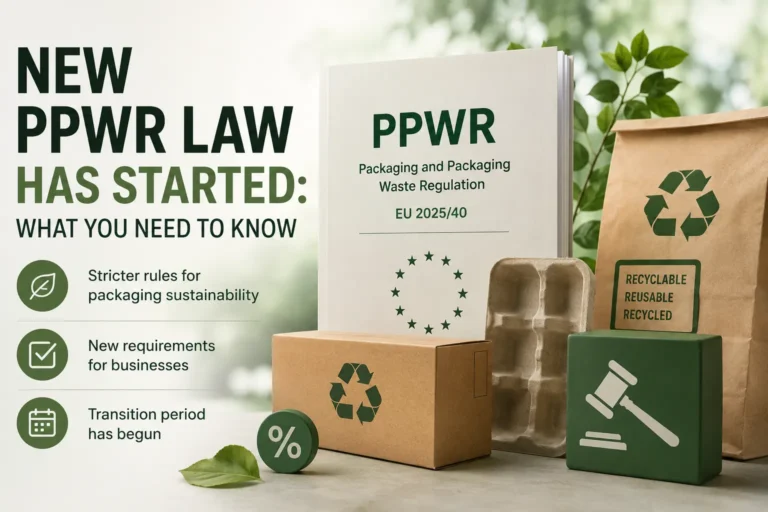
As of 12 August 2026, the EU Packaging and Packaging Waste Regulation (PPWR) — Regulation (EU) 2025/40 — is officially in application across all 27 EU member states. If your brand sells, ships, or manufactures packaging for the EU market, this is the date that mattered most since the regulation was published. Here’s exactly what changed today, what’s now restricted, and what you actually need to do.
What Is the PPWR?
The PPWR replaces the old Packaging and Packaging Waste Directive (94/62/EC), in force since 1994. The key difference is legal form: a directive had to be translated into national law by each EU country, producing 27 different rulebooks. A regulation applies directly and identically in every member state — no transposition, no grace period for existing stock.
The PPWR entered into force in February 2025, giving businesses an 18-month runway. That runway ended on 12 August 2026, when the first binding obligations took effect. It is not a single deadline — it’s a rolling series of milestones running through 2040. What matters right now is the first step of that staircase.
What Exactly Changed on 12 August 2026
Three things became legally binding on this date, with no transitional period:
1. Substance restrictions are now enforceable. PFAS (“forever chemicals”) are restricted in food-contact packaging above these thresholds: 25 ppb for any single non-polymeric PFAS, 250 ppb for the sum of non-polymeric PFAS, and 50 ppm for total fluorine including polymers. Separately, and covering all packaging (not just food-contact), the combined concentration of lead, cadmium, mercury, and hexavalent chromium is now capped at 100 mg/kg.
2. A Declaration of Conformity is now mandatory. Every packaging type placed on the EU market must undergo a conformity assessment and be backed by an EU Declaration of Conformity plus supporting technical documentation, per Articles 38–39 and Annex VII.
3. EPR obligations under harmonized rules are active. Producers must register under Extended Producer Responsibility schemes in each member state where their packaging is first made available. National implementation laws are landing alongside PPWR — for example, Germany’s Packaging Law Implementation Act (VerpackDG) takes effect on the same date to replace the old Verpackungsgesetz.
There’s no grandfathering for the substance limits: packaging placed on the market after 12 August 2026 must meet the PFAS and heavy-metal thresholds, even if it was manufactured earlier. Stock already on the market before that date does not need to be pulled.
What’s Restricted Right Now (and What Isn’t Yet)
This is the part that causes the most confusion, so it’s worth being precise:
Restricted today:
- PFAS above the thresholds above, in food-contact packaging
- Combined heavy metals (lead, cadmium, mercury, hexavalent chromium) above 100 mg/kg, in all packaging
- Placing packaging on the market without a Declaration of Conformity and technical file
Not restricted yet — these come later:
- The Annex V single-use plastic format bans (e.g. single-portion condiment packaging, plastic grouped packaging for cans/bottles, hotel toiletry miniatures, very lightweight plastic bags) apply from 1 January 2030, not today
- Design-for-recyclability performance grades: from 1 January 2030
- The 50% maximum empty-space ratio for grouped, transport, and e-commerce packaging: from 1 January 2030
- Recyclability “at scale”: from 1 January 2035
- Harmonized EU packaging labelling: expected from 12 August 2028
- Minimum recycled-content targets and reuse quotas: phased through 2030–2040
If you’ve seen headlines saying single-use plastic formats are “banned now” — that’s early, and refers to 2030. What’s actually binding today is substances of concern, conformity documentation, and EPR.
What You Need to Do
If you’re a brand owner or procurement lead sourcing packaging for the EU market, here’s the practical checklist:
- Audit food-contact packaging for PFAS. If you use any coatings, laminates, or grease-resistant treatments, confirm testing against the 25/250 ppb and 50 ppm thresholds.
- Confirm heavy-metal compliance across all packaging, not just food-contact — inks, pigments, and coatings are common sources of lead, cadmium, mercury, and hexavalent chromium.
- Get a Declaration of Conformity and technical file for every packaging format you place on the EU market. This is a per-format requirement, not a blanket company statement.
- Check your EPR registration status in every member state where your packaging is first supplied, and confirm whether you need an EU-based Authorised Representative if you’re a non-EU manufacturer.
- Start planning for 2030 now. Recyclability-by-design and minimization requirements typically need 12–24 months of lead time to redesign structures and requalify materials — this is not a 2029 problem to defer.
DST-Pack Is PPWR Compliant
At DST-Pack, our custom packaging, rigid boxes, and advent calendar packaging are produced to meet current PPWR requirements — including substance restrictions on PFAS and heavy metals, and documentation support for your Declaration of Conformity. If you’re reviewing your packaging supply chain against the new obligations, we can talk through what compliance looks like for your specific product and box format.
The Bottom Line
The PPWR is live, but it’s a phased rollout. What’s binding today is substances of concern, conformity documentation, and EPR — not yet the single-use format bans or recyclability grades that dominate the headlines. Getting the current requirements right first, while building toward the 2030 milestones, will save you from an expensive scramble later.