Custom packaging is one of the fastest-growing segments of the global packaging industry. What was once a category dominated by large consumer goods companies with industrial print runs is now accessible to brands of all sizes — and the data reflects that shift. The market is expanding across North America and Europe, driven by the growth of e-commerce, the rise of DTC brands, tightening sustainability regulation, and a fundamental change in how brands think about packaging as a commercial tool rather than a cost line.
This article pulls together the most current market data across the US and key European countries, explains the growth drivers, and provides context for what these numbers mean for brands making packaging decisions today.
The Global Picture
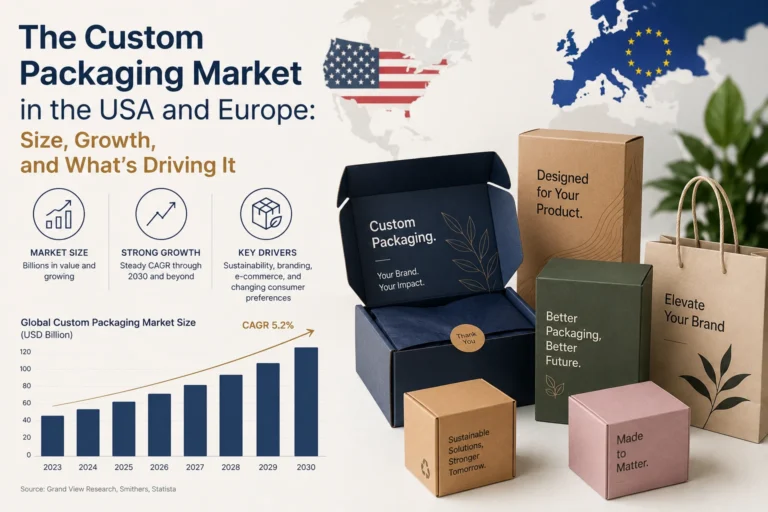
The global custom packaging market was estimated at USD 37.89 billion in 2024 and is projected to reach USD 59.62 billion by 2033, growing at a CAGR of 5.2% from 2025 to 2033. A separate analysis by Towards Packaging puts the figure slightly higher: the customized packaging market is expected to increase from USD 45.31 billion in 2025 to USD 70.47 billion by 2034, growing at a CAGR of 5.03% throughout the forecast period.
The variation between these figures reflects different methodological definitions of “custom packaging” — some analyses include all branded packaging, others focus specifically on bespoke structural design. What both agree on is the direction and magnitude: sustained growth at approximately 5% annually through the next decade, reaching between $60 and $70 billion globally by the early 2030s.
By material, the paper and paperboard segment recorded the largest revenue share of over 47% in 2024 and is expected to grow at the fastest CAGR of 5.5% during the forecast period. This is the segment most relevant to rigid box packaging, gift packaging, and premium paper-based formats — the categories that DST-Pack specializes in and that brands in cosmetics, confectionery, corporate gifting, and luxury retail rely on.
The US Market
North America dominated the custom packaging market with the largest revenue share of over 32% in 2024.This makes North America — overwhelmingly driven by the United States — the single largest regional market in the world for custom packaging.
North America dominated the Custom Packaging Market in 2025 and is expected to maintain its dominance during the forecast period of 2026–2032. The region’s leadership is primarily driven by the strong presence of established packaging companies, high adoption of advanced printing technologies, and growing demand for personalized packaging solutions across industries such as food and beverages, cosmetics, and consumer goods. Furthermore, the rapid growth of e-commerce and direct-to-consumer brands in the United States and Canada has significantly increased the demand for customized packaging that enhances brand visibility and customer experience.
Several structural factors make the US the dominant custom packaging market globally:
E-commerce penetration. The US has one of the world’s most developed DTC e-commerce ecosystems, with millions of brands shipping directly to consumers for whom the unboxing experience is a primary brand touchpoint. Every DTC shipment is a packaging decision, and the brands winning in this environment are investing in packaging that creates brand recognition and repeat purchase behavior.
Corporate gifting culture. The US corporate gifting market is substantial — branded gift boxes for client appreciation, employee onboarding, and event activations represent consistent, recurring demand for premium custom packaging at business quantities. This is a distinctly American commercial practice at the scale it operates, and it generates significant packaging volume across categories from food and confectionery to technology accessories and wellness products.
Brand differentiation competition. US consumer goods markets are highly competitive, and packaging has become a primary differentiator in crowded categories. This is particularly visible in food, beverages, cosmetics, and wellness — all categories experiencing rapid growth in custom packaging spend.
The European Market
Europe is the world’s second-largest packaging market overall and the largest single market for luxury packaging. Europe accounts for the largest market share of the global luxury packaging market, driven by the strong presence of recognized international luxury brands in the region.
Europe is anticipated to grow at a significant rate, with a market value of USD 100.23 billion in 2023 for paper packaging and projected to expand at a CAGR of 4.2% from 2023 to 2030. The demand for eco-friendly and sustainable packaging solutions is increasing due to growing environmental concerns.
The European packaging market is shaped by two forces that are unique in their intensity compared to other regions: regulatory pressure and luxury brand heritage. The EU’s Packaging and Packaging Waste Regulation (PPWR), which entered into force in January 2025, sets binding recyclability requirements for all packaging sold in the EU by 2030. The PPWR entered force in January 2025, obliging all packaging sold in the EU to be recyclable by 2030 and setting material-specific recycled-content quotas.
This regulatory context is actively driving material shifts in European packaging — away from complex laminates and non-recyclable plastics, toward paper-based and mono-material formats. For premium rigid box packaging specifically, this is a structural tailwind: paper-based rigid box construction is inherently recyclable and aligns naturally with the direction of EU regulation.
Germany: Europe’s Largest Packaging Market
Germany is the largest national packaging market in Europe and one of the most sophisticated in the world. Germany remains the anchor of the European plastic packaging market with a 23.75% share in 2025, supported by EUR 100 billion in annual plastics turnover and 310,000 employees.
Beyond raw market size, Germany’s packaging market is characterized by exceptionally high standards for material documentation, sustainability credentials, and production consistency. The Verpackungsgesetz (VerpackG) has been in force since 2019, requiring all companies placing packaged goods on the German market to register with the LUCID Packaging Register and participate in a dual system for packaging recycling. This regulatory maturity means German buyers are among the most specification-literate in Europe — they expect precise material data, FSC certification where claimed, and verifiable compliance documentation.
German demand for premium paper-based packaging is concentrated in cosmetics (particularly in Hamburg, Munich, Düsseldorf, and Berlin), confectionery and chocolate (Germany has one of the highest per-capita chocolate consumption rates in the world), wine and spirits, and corporate gifting. Germany, France, Italy, and the UK played a leading role in Europe’s packaging market in 2024.
France: Luxury, Gastronomy, and the World’s Most Demanding Premium Market
France is the world capital of luxury, and its packaging market reflects that. The French premium packaging segment — covering cosmetics, perfumery, wine and Champagne, confectionery, and luxury goods — sets global standards that buyers in other markets measure against.
France hosts over 55,800 food-processing firms generating €170 billion in revenue, making it one of the largest food packaging end-markets in Europe. The luxury packaging segment in France benefits from the concentration of global luxury houses — LVMH, Kering, L’Oréal, and their portfolio brands — that use France as the reference market for premium packaging design and quality.
The French packaging market is also being actively reshaped by the loi AGEC (Anti-Gaspillage pour une Économie Circulaire), which introduces progressive obligations on recyclability, recycled content, and producer responsibility. French brands sourcing packaging need material documentation that supports their CITEO (REP Emballages) declarations — a requirement that is driving brands toward suppliers who can provide comprehensive material data.
Germany, the UK, and France are the primary consumers in the European flexible packaging market. In premium rigid box packaging, France’s demand is concentrated in cosmetics and beauty, wine and Champagne (the Champagne region alone generates significant gift packaging volume), confectionery (particularly chocolate), and luxury retail.
Italy: Design Heritage and a Confectionery Tradition
Italy’s packaging market is defined by the intersection of world-class design culture and deep craft food tradition. Italian packaging buyers — whether in cosmetics (concentrated in Milan and the north), wine (Barolo, Brunello, Prosecco, Amarone producers all require premium gift packaging), or confectionery (panettone, pralines, confetti) — bring aesthetic standards shaped by centuries of Italian design sensibility.
Italy’s role in European packaging is characterized by diverse consumption patterns: olive oils in metal tins, fresh produce in films, cold cuts in trays, and confectionery in blends. The premium paper packaging segment in Italy is particularly strong in confectionery gifting — the panettone market alone generates enormous seasonal packaging demand, and Italian chocolatiers and confectionery producers are significant buyers of custom rigid box packaging.
Italy also has its own labeling regulation that adds complexity for pan-European packaging decisions: Italy’s labeling statute requires granular disposal instructions, complicating shared artwork for pan-EU launches. This makes Italy a market where packaging documentation and compliance support from the supplier is a genuine differentiator.
Poland: The Fastest-Growing Packaging Market in Central Europe
Poland has emerged as one of the most significant packaging markets in Central Europe, with growth rates that consistently outpace Western European counterparts. Poland exhibits the fastest growth at a 6.65% CAGR thanks to its USD 688 billion food-processing base and a retail packaged-food channel forecast to hit USD 50.3 billion by 2028.
Poland’s packaging market growth is driven by several converging factors: a rapidly developing domestic consumer goods sector, significant foreign direct investment in Polish manufacturing, and Poland’s role as a production and distribution hub for Central and Eastern Europe. Polish brands — particularly in cosmetics, food, and e-commerce — are increasingly investing in premium packaging as they scale and compete for shelf space in Western European markets.
The Polish premium packaging segment is growing fastest in cosmetics (Poland has a strong and growing domestic cosmetics industry), confectionery, corporate gifting, and the expanding DTC e-commerce sector. Poland is also a significant market for advent calendar packaging — the tradition is embedded in Polish culture and generates strong seasonal demand.
Eastern Europe is expected to be a significantly growing region in the studied years. A key catalyst is that Poland and other Eastern European countries facilitate minimal production and labor expenditures as compared to Western Europe.
The Netherlands: E-Commerce Leadership and Sustainability Ambition
The Netherlands punches above its weight in the European packaging market. As one of Europe’s most developed e-commerce markets and a significant logistics hub, Dutch packaging demand is shaped by both DTC brand requirements and the transit packaging needs of goods moving through Rotterdam and Schiphol.
The Netherlands leads on fossil-free packaging goals, while Belgium attains 79.2% recycling rates. Dutch sustainability expectations in packaging are among the highest in Europe — a direct reflection of both government policy and genuinely high consumer consciousness on environmental issues. Dutch buyers sourcing premium packaging increasingly request FSC-certified materials, documented recyclability, and reduced plastic content as baseline requirements rather than differentiators.
Spain: Wine, Food, and a Growing Premium Segment
Spain’s packaging market is large — the fifth-largest in the EU — and is growing at rates that reflect both domestic consumption growth and Spain’s significant role as a food and beverage exporter. The Spanish wine industry alone — producing Rioja, Ribera del Duero, Cava, Sherry, and dozens of other appellations — generates consistent demand for premium wine gift packaging.
Spain’s confectionery market creates seasonal packaging demand anchored around Christmas traditions (turrón, mazapán, polvorones) that have no direct equivalent in Northern European markets. Spanish food brands packaging these categories for premium retail and export need rigid box packaging that communicates quality and tradition.
The Key Drivers of Growth — Across Both Markets
Whether looking at the US or European markets, the same structural forces are driving custom packaging growth:
E-commerce and DTC expansion. The packaging market is valued to increase by USD 327.1 billion from 2025 to 2030, driven by the proliferation of global e-commerce and last-mile logistics efficiency. Every e-commerce shipment that arrives in premium branded packaging is a brand impression. The proliferation of DTC brands has created millions of new packaging buyers who would not have existed in a traditional retail-only world.
Sustainability regulation. The EU’s PPWR, California’s SB 54, and the UK’s extended producer responsibility framework are all pushing packaging toward recyclable, renewable, and documented materials. Paper-based rigid packaging is well-positioned in this regulatory environment — recyclable, FSC-certifiable, and made from a renewable resource.
Brand differentiation. In saturated consumer goods categories, packaging has become a primary differentiator. Market growth is driven by increasing brand differentiation needs and rising demand for personalized, sustainable, and innovative packaging solutions that enhance customer experience.
The unboxing economy. Social media has made packaging a marketing channel. Unboxing content is one of the most watched categories on YouTube and among the most shared on Instagram and TikTok. Brands that invest in premium packaging generate organic content that would cost significantly more to produce as paid advertising.
Luxury packaging growth. The global luxury packaging market size reached USD 18.2 billion in 2025 and is expected to reach USD 25.1 billion by 2034, exhibiting a growth rate of 3.55% during 2026–2034. The luxury packaging segment — which includes premium rigid boxes, specialty paper packaging, and high-end gift packaging — is growing steadily and is concentrated precisely in the categories that DST-Pack serves.
What This Means for Brands Sourcing Packaging Now
The market data points to several practical conclusions for brands making packaging decisions in 2025 and beyond.
Paper-based rigid packaging is the fastest-growing material segment in both markets. The combination of consumer preference for premium tactile experience, regulatory pressure away from non-recyclable materials, and the growth of gifting and DTC channels all favor paper-based rigid box construction. Brands investing in this format now are positioning themselves well for where both regulatory requirements and consumer expectations are heading.
Minimum order quantities are no longer a barrier. The growth of the custom packaging market has been accompanied by the development of suppliers who can produce at smaller quantities — enabling brands earlier in their growth journey to access premium custom packaging. DST-Pack produces from 100 units, making custom rigid box packaging accessible at quantities that match DTC and early-stage brand realities.
Material documentation is becoming a baseline requirement. In both the US (particularly California) and Europe (under the PPWR and national legislation), brands are increasingly required to document the materials in their packaging for regulatory compliance and retail buyer approval. Packaging suppliers who provide full material specifications, FSC chain of custody documentation, and food safety compliance records are becoming easier to work with than those who cannot.
The market is large and growing, but the competition for quality suppliers is real. At a market of $45+ billion and growing at 5% annually, demand for quality custom packaging is outpacing the capacity of suppliers who can actually deliver consistent premium quality at accessible quantities. Finding a supplier with demonstrable production quality, physical sample processes, and material documentation capability is a genuine competitive advantage for a brand.
DST-Pack and the Premium Custom Packaging Market
DST-Pack produces fully custom paper and rigid box packaging for brands across the US and Europe — the two largest markets in the world for custom packaging. Our production covers rigid magnetic closure boxes, drawer-style boxes, base and lid boxes, paper tubes, and custom insert systems, from 100 units, with FSC-certified material options and full material documentation for regulatory compliance in both the US and EU markets.
Every order begins with a physical sample before production. If you are building a brand in any of the markets covered in this article — and looking for a packaging partner who understands both the quality requirements and the compliance context — the conversation starts with a brief.
Sources:
- Grand View Research — Custom Packaging Market Size, Share & Industry Report 2033
- Towards Packaging — Customized Packaging Market Size, Share, Trends and Growth Forecast
- Maximize Market Research — Custom Packaging Market 2026–2032
- IMARC Group — Luxury Packaging Market Size, Share, Trends Report 2034
- Market Data Forecast — Europe Food Packaging Market Size & Share 2033
- Towards Packaging — Europe Flexible Packaging Market Size & Trends 2026–2035
- Mordor Intelligence — Europe Consumer Packaging Market
- Mordor Intelligence — Europe Plastic Packaging Market
- Technavio — Packaging Market Growth Analysis 2026–2030
- Globe Newswire — Custom Packaging Market to Hit USD 63.07 Billion by 2030