If you’ve ever requested a quote for custom packaging and seen a line item like “die cost: $180” or “cutting tool fee: $250” sitting on top of your per-unit price, you’ve run into one of the least-explained costs in the packaging industry. It’s not a hidden fee — the underlying cost is real — but almost nobody explains why it exists, whether it’s negotiable, whether it’s one-time or recurring, or when you’re expected to pay it again on a reorder.
It’s worth understanding, because it’s rarely trivial. For a brand ordering a few hundred units, a $150–$400 tooling charge can meaningfully shift the per-unit economics of a small run. For a brand comparing several factory quotes side by side, tooling fees are one of the most common reasons two quotes that look wildly different on paper actually land close together once every line item is accounted for — or, just as often, why two similar-looking quotes hide very different real costs. Knowing what the fee actually pays for, and how factories decide whether to charge it, makes it much easier to compare quotes accurately and negotiate from an informed position.
What a Die-Cutting Tool Actually Is
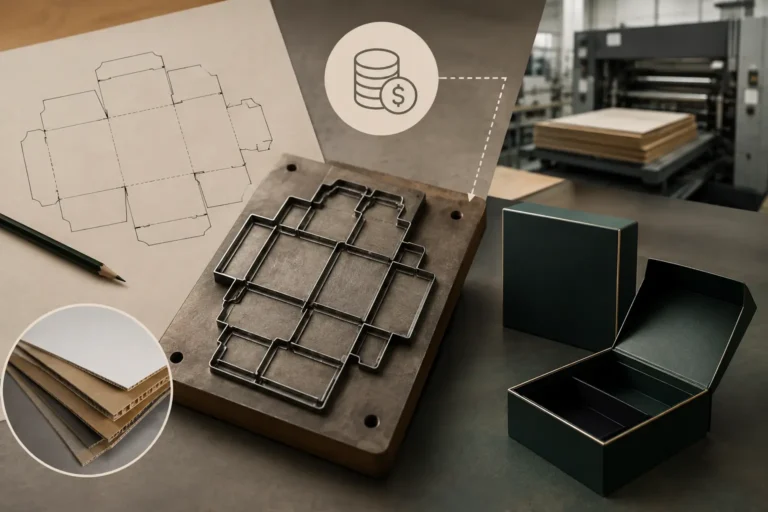
A die-cutting tool — often just called a “die” or “knife” in factory shorthand — is a custom-made cutting template used to cut flat sheets of cardboard, paperboard, or corrugated material into the exact shape needed to fold into your box. Picture a large wooden board with thin steel blades bent and mounted into it, following the precise outline of your box’s net (the flattened, unfolded shape). When a sheet of material is pressed against the die under a hydraulic or mechanical press, the blades cut through it in one motion — producing the shape, along with any tabs, slots, or fold lines, in a single pass.
It isn’t a generic tool. It’s built specifically for your box’s dimensions and structural design, so a different size or a different closure style — say, switching from a straight tuck-end to a magnetic closure with a locking tab — requires a new die.
A few different die types are used across the industry, and the type affects both cost and turnaround:
- Flatbed dies — the most common type for folding cartons and rigid box components, used on flatbed die-cutting presses. Relatively fast to produce (often a few days) and the most affordable option for standard box structures.
- Rotary dies — cylindrical dies mounted on a rotating drum, used for high-volume corrugated production where throughput matters more than intricate detail. More expensive to produce than flatbed dies, but far faster once running, which makes them worthwhile at higher volumes.
- Steel rule dies vs. forme dies — steel rule dies use thin, sharpened steel strips bent into shape and set into a wooden or plywood board (the traditional, lower-cost method). Forme dies, sometimes called solid dies, are precision-machined from solid steel or aluminum, offering more accuracy and durability for complex or high-run production at a higher upfront cost.
Structural complexity has a direct, sometimes non-obvious effect on cost. A simple straight-line tuck box takes far less die-making labor than one with curved edges, internal partitions, multiple locking tabs, or a display window cutout — every added structural feature means more precise blade-bending or machining work, and more time on the factory floor before a single box gets cut.
Why It’s Billed Separately From Your Per-Unit Price
A die-cutting tool is a fixed, one-time cost — it doesn’t scale with how many boxes you order. Cutting 500 boxes or 50,000 boxes with the same die costs the factory the same amount to make the die; only the run time and materials scale with volume.
Because of that, factories generally have two options for how to bill it:
- Charge the die cost separately, upfront, as a one-time fee — then quote a lower, cleaner per-unit price that reflects only material, printing, and labor.
- Fold the die cost into the per-unit price, spreading it across the order quantity — so the per-unit number is technically higher, but there’s no separate line item on the invoice.
Most factories go with the first option, for reasons that are more about protecting their own business model than anything else:
- It protects them on low-volume orders. If a customer orders a small batch and never reorders, the factory recoups the tooling cost immediately, rather than absorbing it into a per-unit price that may never sell enough volume to cover it.
- It simplifies reorders. Since the die is a physical object the factory keeps on file, a customer reordering the same box design later often doesn’t pay the fee again — it’s a one-time cost tied to the design, not the individual order.
- It’s an easy, uncontroversial fee to justify. Because the underlying cost is real and tangible — a physical tool exists at the end of it — customers rarely push back on it the way they might on a less obvious markup elsewhere in the quote.
None of this makes the fee illegitimate; the tooling genuinely costs money to produce. But it does mean the fee reflects a business decision about how to present pricing, not a fixed law of the industry. That distinction matters, because it means the fee is negotiable — and some factories choose not to charge it at all.
What Actually Drives the Price of a Die
Die costs vary widely: anywhere from roughly $50 for a simple flatbed die on a small folding carton, up to several hundred dollars or more for a large, structurally complex rigid-box die with multiple locking features. A few factors determine where a given project falls on that range:
- Size of the box. Larger dies require more steel rule (or more machining, for forme dies) and a larger board or plate, which raises both material and labor cost.
- Number of cutting lines and creases. Every additional fold line, perforation, or cut path adds time spent bending and setting the blades precisely.
- Tolerances required. Packaging that has to nest tightly with a product — a custom insert tray, for example — needs tighter cutting tolerances, which takes more precision and more time to get right.
- Die type, as covered above — rotary and forme dies cost more upfront than flatbed steel rule dies.
- Factory location and labor cost. Die-making is still a fairly labor-intensive, skilled trade, so costs vary by region for the same reasons general manufacturing costs do.
Knowing these factors is useful beyond just understanding your invoice: if a die fee seems unusually high relative to a simple box design, it’s a normal and reasonable thing to ask your factory to break down.
When You Should — and Shouldn’t — Expect to Pay It Again
A few practical rules of thumb worth keeping in mind with any packaging factory:
- Same design, same factory, reordering later: the die should already be on file — you typically shouldn’t be charged again.
- Same design, different factory: expect to pay for a new die, since dies aren’t usually transferable between factories, which run different press equipment and mounting specs.
- Same box structure, different dimensions: a new die is required, since the cutting path itself has to change.
- Same dimensions, different print or material: usually no new die needed — the die only cuts the shape, while printing and lamination happen separately.
It’s worth asking directly whether your factory retains your die, and for how long. Some discard tooling after a period of inactivity — often 6 to 12 months — which means a “reorder” after a long gap can trigger a new die fee even though nothing about the design changed.
Our Approach at DST-Pack
In most cases, DST-Pack doesn’t charge a separate die-cutting tool fee for custom packaging orders. We treat tooling as part of the cost of building a working relationship with a customer, not a separate revenue line: if we’re already doing the design and structural engineering work with you, the tooling cost is accounted for in how we structure the overall project rather than surfacing as a surprise line item once a design is finalized.
There are edge cases where this doesn’t apply — extremely low-volume one-off orders, unusually complex die structures requiring specialized equipment, or dies for a design that’s abandoned before production — and we’ll always flag those upfront rather than let them show up unexpectedly on an invoice. For the overwhelming majority of custom box orders we run, though, the per-unit price you’re quoted is the price you pay, with no separate tooling fee stacked on top.
We take this approach for a simple reason. By the time a customer is ready to move into production, we’ve usually already spent time together finalizing structural design, material selection, and print specs. Charging a tooling fee at that stage feels less like recovering a real cost and more like a toll placed at the exact moment a customer is most committed to moving forward — so we’d rather build that cost into how we price and structure projects from the start, so the number you see early in the conversation is the number that holds up at the end of it.
If you’re comparing quotes across factories and see a tooling fee on one and not the other, it’s worth asking directly what’s actually included. Sometimes a “no die fee” factory has simply built the cost into a higher per-unit price instead — something that only becomes clear once you compare true landed cost per unit, including tooling, freight, and duties, rather than comparing individual line items in isolation. A quote that looks 10% cheaper on paper can end up more expensive once every real cost is accounted for, and a quote that lists a die fee transparently upfront is often more trustworthy than one that quietly folds it in.
The Bigger Picture
Die-cutting tooling is just one of several one-time setup costs that show up across the packaging production process — printing plates for offset runs, sample development fees, and mold costs for thermoformed inserts all follow a similar logic: a fixed cost that some factories bill separately and others absorb into per-unit pricing. None of these fees are inherently unfair, but none of them are standardized across the industry either, which is exactly why it pays to ask factories directly how each one is handled before comparing quotes side by side.
If you’re currently sourcing custom packaging and want to see exactly how your project’s numbers break down — with no surprise tooling fees added later — we’re happy to walk you through it.