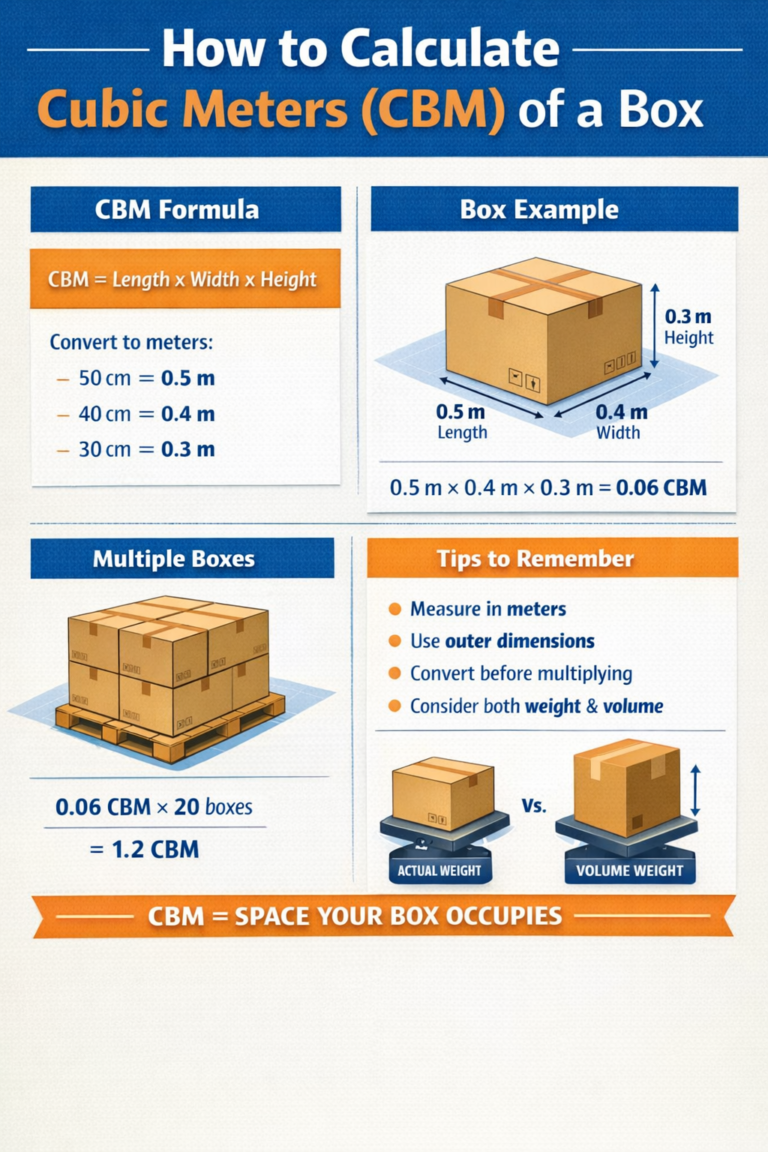
Cubic meter (CBM) is one of the most important measurements used in logistics, packaging, and international shipping. Whether you are shipping custom boxes, exporting goods, or calculating freight costs, knowing how to calculate CBM correctly helps you avoid pricing mistakes and unexpected shipping charges.
What Is CBM?
CBM stands for cubic meter, a unit of volume used to measure how much space a box, carton, or shipment occupies. Shipping companies use CBM to calculate costs for sea freight, air freight, and sometimes even road transport—especially when goods are bulky but not very heavy.
In simple terms, CBM tells you how much physical space your box takes up, not how much it weighs.
Basic Formula for CBM
The CBM of a box is calculated using three dimensions:
- Length
- Width
- Height
The standard formula is:
CBM = Length × Width × Height
Important: all measurements must be in meters.
Step-by-Step Example
Let’s say you have a cardboard box with the following dimensions:
- Length: 50 cm
- Width: 40 cm
- Height: 30 cm
First, convert centimeters to meters:
- 50 cm = 0.5 m
- 40 cm = 0.4 m
- 30 cm = 0.3 m
Now apply the formula:
0.5 × 0.4 × 0.3 = 0.06 CBM
So, one box occupies 0.06 cubic meters.
Calculating CBM for Multiple Boxes
If you are shipping more than one identical box, multiply the CBM of one box by the total quantity.
Example:
- CBM per box: 0.06
- Number of boxes: 20
Total CBM = 0.06 × 20 = 1.2 CBM
This number is what freight forwarders will use to calculate shipping costs.
CBM for Irregular or Assembled Packaging
For boxes with unusual shapes, inserts, or assembled displays, CBM is still calculated using the outer dimensions of the packaging. Always measure the maximum length, width, and height once the box is fully assembled.
This is especially important for:
- Rigid boxes
- Gift boxes with lids
- Foldable boxes shipped assembled
- Multi-pack cartons
Shipping companies charge based on the space the package occupies, not the internal usable volume.
CBM vs Weight: Why It Matters
In many cases, shipping companies compare:
- Actual weight
- Volumetric (CBM-based) weight
They charge based on whichever is higher. This means a lightweight but large box can be more expensive to ship than a smaller, heavier one.
That’s why optimizing packaging size is critical for cost-efficient logistics.
Common Mistakes to Avoid
- Forgetting to convert cm to meters
- Measuring internal dimensions instead of outer dimensions
- Ignoring lid height or protective packaging
- Rounding numbers too aggressively
Even small errors can lead to higher shipping costs when scaled across large volumes.
Why CBM Calculation Is Important for Packaging Planning
Understanding CBM helps you:
- Estimate shipping costs accurately
- Choose the right box size
- Optimize pallet loading
- Reduce wasted space
- Improve overall supply chain efficiency
For businesses producing custom packaging, CBM calculation should always be part of the design and logistics planning process.
Final Thought
Calculating CBM is simple, but it plays a major role in shipping and packaging decisions. By measuring correctly and understanding how CBM works, you can avoid surprises, reduce costs, and plan logistics more efficiently—especially when shipping custom boxes internationally. DST-Pack, as a reliable packaging manufacturer, can support you on every step!