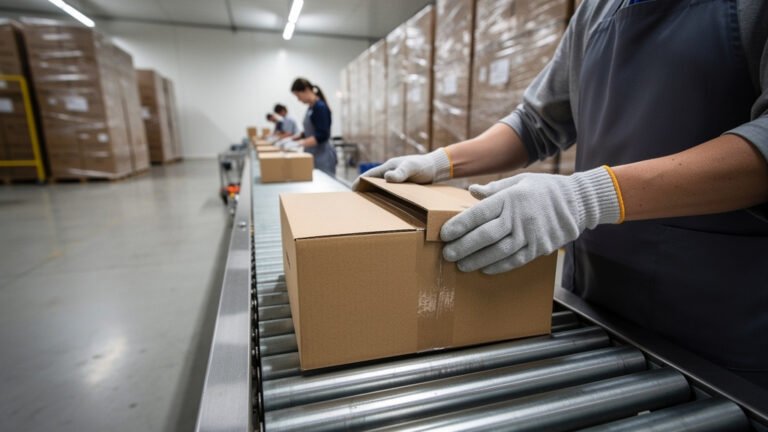
A line of finished hot-sauce bottles moves down a conveyor, gets labeled, sleeved, and drop-shipped to a national retailer — all without the brand owner ever touching a single cap. That’s contract packaging at work. Contract packaging (also called co-packing) is the practice of hiring a third-party company to handle some or all of a product’s packaging operations on behalf of the brand or manufacturer. It covers everything from filling and sealing to labeling, kitting, and palletizing, and it’s far more common than most consumers realize.
According to the Packaging Machinery Manufacturers Institute’s 2023 industry survey, roughly 60 percent of consumer packaged goods companies in the U.S. use some form of outsourced packaging, a figure that has been largely stable since the late 2010s.
In brief
- Contract packaging means paying a specialist company to pack your product instead of doing it in-house.
- Co-packers can handle food, beverage, personal care, household goods, pharmaceuticals, and industrial products.
- The brand retains ownership of the formula or product; the co-packer provides labor, equipment, and facilities.
- Key benefits include lower capital expenditure, faster time to market, and access to certifications you’d otherwise have to earn yourself.
- Co-packing differs from co-manufacturing: a co-packer packages a finished or near-finished product; a co-manufacturer may also make it.
What co-packing is, and what it isn’t
The co-packing definition trips people up because “packaging” covers a surprisingly wide range of activities. At its narrowest, a co-packer might do nothing more than place pre-filled pouches into a branded shipper box. At its broadest, the same facility might receive raw ingredients, blend them, fill them into containers, apply shrink-wrap sleeves, build retail-ready displays, and arrange the outbound freight.
Co-packing is not co-manufacturing, though the two terms get muddled constantly, including by people who should know better. They exist on a spectrum. A co-manufacturer takes on the production of the product itself: mixing, cooking, extruding, fermenting. A co-packer takes over once the product (or a close version of it) already exists. In practice, many facilities do both, which is why “co-manufacturing and co-packing” appears so often in supplier directories.
The counter-intuitive part: some of the largest food brands in America use co-packers not because they lack production capacity, but because they want surge flexibility. When a product goes viral on social media and demand triples in six weeks, a brand with fixed in-house lines has a serious problem. A co-packer with idle capacity doesn’t.
How the contract packaging process works
The typical process moves through five phases, though the sequence shifts depending on the category and the complexity of the pack format.
- Discovery and quoting. The brand shares a product spec, target pack format, volume forecast, and any regulatory requirements (organic certification, kosher, etc.). The co-packer quotes a per-unit rate, usually with a minimum order quantity.
- Trial run. A small pilot batch, often 500 to 2,000 units, tests whether the line settings, materials, and speeds match spec. This is where most problems surface, and catching them here is far cheaper than a full production run.
- Artwork and compliance sign-off. Labels, carton artwork, and any claims (non-GMO, allergen statements) go through a formal approval before printing. For food co-packing in particular, FDA labeling compliance is the brand’s legal responsibility, not the co-packer’s, a distinction that surprises first-time clients.
- Full production. Runs can be weekly, monthly, or campaign-based. The co-packer tracks yield, waste, and any line stoppages.
- Fulfillment or handoff. Finished goods either ship directly to a retailer or 3PL warehouse, or return to the brand’s own distribution center.
One non-obvious detail about step two: the trial run fee is often non-negotiable and non-refundable, even if the brand walks away. It compensates the co-packer for line setup time, which can run four to eight hours on complex formats.
The real benefits of contract packaging
The standard pitch for outsourcing focuses on capital: you avoid buying a $400,000 filling line and the building to put it in. True. But the more durable benefits are less visible.
Certifications and audits. A food co-packing facility certified to SQF (Safe Quality Food) Level 2 or higher has already passed the audit that major grocery retailers require. A startup brand plugging into that facility inherits the audit standing for its products, not the certificate itself, but the retailer relationship that flows from it. Earning that standing independently could take two to three years.
Speed to market. A brand that would need 18 months to build, equip, and staff its own packaging line can be on shelf in 90 days through a contract packaging company with available capacity. In categories with short trend windows, functional beverages, seasonal confectionery, limited-edition personal care, 90 days versus 18 months is a meaningful gap.
Labor insulation. Packaging lines are labor-intensive and turnover-prone. The co-packer absorbs the hiring, training, and retention burden. From the brand’s perspective, it becomes a line item on an invoice rather than an HR problem.
If you’re weighing whether to build in-house or outsource, the honest question isn’t “which is cheaper per unit?” It’s “what is my realistic volume in 24 months, and how wrong could I be?” Co-packing is a hedge against being wrong in either direction.
Co-packing services by category: food, beverage, and beyond
Food co-packing gets most of the attention. The U.S. food and beverage co-packing market was valued at roughly $27 billion in 2022, according to Grand View Research. But the same model runs across nearly every consumer category.
- Food and beverage: dry goods, snacks, sauces, frozen meals, ready-to-drink beverages, supplements. Often the most regulated, requiring FSMA (Food Safety Modernization Act) compliance in the U.S.
- Personal care and beauty: lotions, shampoos, cosmetics. Requires Good Manufacturing Practice (GMP) compliance; some facilities hold FDA cosmetic registration.
- Household and cleaning products: aerosols, liquids, tablets. Flammability and chemical compatibility add complexity.
- Pharmaceuticals and nutraceuticals: the most tightly regulated tier; requires FDA registration, cGMP (current Good Manufacturing Practice), and often DEA scheduling awareness.
- Industrial and hardware: kitting (assembling multiple components into one retail pack), blister-packing fasteners, shrink-wrapping tool sets.
Kitting deserves a separate note. Assembling a gift set, a subscription box, or a multipack from individual SKUs requires almost no specialized machinery but enormous amounts of careful human labor. It’s one of the fastest-growing segments, driven by the e-commerce subscription economy.
What a contract packaging company actually looks like
There’s no single profile. The industry ranges from 10-person shops with two filling lines to publicly traded contract manufacturers running dozens of facilities across the country. A few things separate the serious operators from the rest.
First, third-party audits. Any co-packer worth hiring in the food or personal care space holds at least one third-party certification: SQF, BRC (British Retail Consortium), or AIB International. Asking for the certificate number and verifying it on the certifying body’s public database takes five minutes and eliminates a lot of risk.
Second, line breadth. A co-packer with only one fill head and one labeler has a single point of failure. Facilities with redundant equipment can keep production running when a machine goes down for maintenance.
Third, and this one gets overlooked: minimum order quantities that match your actual volume. A co-packer optimized for runs of 50,000 units will not give a startup ordering 2,000 units meaningful attention. Matching scale to scale matters as much as matching category expertise.
From what we’ve seen in how brands describe their co-packing relationships, the ones that go badly almost always share one feature: the brand underestimated how much specification work falls on their own team before the co-packer can do anything. The co-packer runs the line; the brand has to tell them exactly what to run.
Co-packing vs contract manufacturing: drawing the line
The co-packing vs contract manufacturing distinction matters most when you’re signing a contract, because the liability terms differ significantly.
In a pure co-packing arrangement, the brand typically supplies the finished or bulk product and the packaging materials. The co-packer provides labor and equipment. If the product is defective, wrong formula or contaminated ingredient, liability sits with the brand.
In a co-manufacturing arrangement, the manufacturer may source ingredients, produce the product, and pack it. Liability for the product itself becomes more negotiable and more contested. A brand that doesn’t spell out indemnification clearly in a co-manufacturing agreement has created a legal exposure it may not discover until something goes wrong.
A useful shorthand: co-packing is a service; co-manufacturing is a partnership. The paperwork should reflect that distinction.
Contract packaging solutions increasingly blur this line on purpose, offering “full turnkey” services where the co-packer sources ingredients, produces, packs, labels, and ships. For small brands with limited operational bandwidth, that’s genuinely useful. For brands that care about proprietary formulas, handing that much control to a single vendor is a concentration risk.
How to find and vet a co-packer
The search process is less glamorous than the strategy conversation, but it determines the outcome.
Industry directories like the Contract Packaging Association’s member database (contractpackaging.org) and ThomasNet list U.S.-based co-packers by category, certifications, and geography. Trade shows, particularly the PACK EXPO events in Chicago and Las Vegas, remain the most efficient way to meet operators and see equipment running in person.
Once you have a shortlist, the vetting process should include:
- A facility tour, ideally unannounced or with minimal notice
- A review of the most recent third-party audit report (not a summary, the full report)
- Reference calls with two or three current clients of similar scale
- A detailed review of the Master Service Agreement, particularly the sections on minimum runs, lead times, price escalation triggers, and IP ownership of any custom tooling
The price escalation clause deserves specific attention. Co-packers’ costs, labor, film, corrugate, energy, move with inflation. A contract that locks in a per-unit rate for 24 months with no adjustment mechanism either gets renegotiated under duress or produces a co-packer who cuts corners to protect margin. Neither outcome serves the brand.
Conclusion
Contract packaging isn’t a shortcut. It’s a structural decision about where a company’s operational energy should go. For brands that want to compete on product, marketing, and distribution rather than on production efficiency, outsourcing packaging to a specialist almost always makes sense, at least in the early and middle stages of growth. The economics shift when volume is high enough and consistent enough to justify owned infrastructure, but that threshold is higher than most founders expect, typically north of several million units annually for most categories.
The practical takeaway: before you sign with a co-packer, write your product specification in enough detail that a stranger could run the line without calling you. If you can’t do that yet, the co-packer conversation is premature. When you can, the right contract packaging company can take a product from bulk to retail shelf faster and more reliably than almost any in-house build. Start with the Contract Packaging Association’s directory, request three facility tours, and ask every reference contact the same question: “What did you wish you’d known before you started?”
That answer, more than any sales pitch, will tell you what you actually need to know.
Sources
- Contract Packaging Association — industry directory and member resources
- Packaging Machinery Manufacturers Institute (PMMI) — 2023 industry survey data on outsourced packaging adoption
- Grand View Research — U.S. food and beverage co-packing market sizing (2022 figures; 2024-25 segment data not yet publicly available)
- U.S. Food and Drug Administration — FSMA compliance requirements and GMP standards for food and personal care co-packers
- Wikipedia — Contract manufacturing — general reference on co-manufacturing and co-packing definitions
- Coverage in trade outlets including Packaging Digest, Food Processing, and Contract Packaging magazine
- Editorial observations drawn from industry pattern analysis (where “we” appears in the text)