If you have ever shipped a box internationally and felt surprised by the freight cost, you are not alone. One of the most common reasons for higher-than-expected shipping prices is chargeable weight. Understanding what chargeable weight is—and why shipping companies use it—can help businesses plan packaging better, avoid confusion, and reduce logistics costs.
What Is Chargeable Weight?
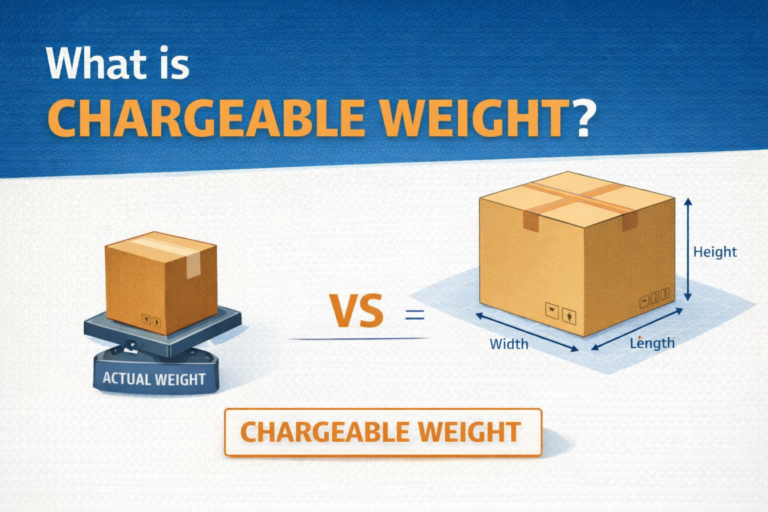
Chargeable weight is the weight used by shipping companies to calculate freight costs. It is not always the same as the actual (physical) weight of a shipment.
Instead, shipping companies compare two values:
- Actual weight (how much the shipment really weighs)
- Volumetric weight (also called dimensional or volume weight)
Whichever value is higher becomes the chargeable weight.
This system is used by:
- Air freight carriers
- Courier services (DHL, UPS, FedEx, etc.)
- Some road and rail freight operators
Actual Weight vs Volumetric Weight
Actual weight is simple—it’s the number you see on a scale.
Volumetric weight, however, is based on the space a shipment occupies, not its mass. This is especially important for lightweight but bulky items, such as empty boxes, gift packaging, foam inserts, or display packaging.
Shipping companies calculate volumetric weight using a formula like:
Length × Width × Height ÷ volumetric divisor
The divisor depends on the shipping method, but common examples are:
- Air freight: 6000 or 5000
- Courier services: 5000
Measurements are usually in centimeters, and the result is in kilograms.
Example of Chargeable Weight Calculation
Imagine this shipment:
- Actual weight: 8 kg
- Box dimensions: 60 × 50 × 40 cm
Volumetric weight calculation:
60 × 50 × 40 ÷ 5000 = 24 kg
Even though the box weighs only 8 kg, the chargeable weight becomes 24 kg, because it takes up significant space in the aircraft or vehicle.
This is why the shipping cost feels much higher than expected.
Why Shipping Companies Use Chargeable Weight
Shipping space is limited and valuable. Whether a package is heavy or light, it still occupies physical space.
A large, lightweight box can:
- Block space that could be used for heavier cargo
- Reduce loading efficiency
- Increase fuel consumption per shipment
Charging only by actual weight would make shipping bulky items unprofitable for carriers. Chargeable weight ensures that shipping costs reflect both space and weight, not just one factor.
When Chargeable Weight Matters Most
Chargeable weight becomes especially important when shipping:
- Custom packaging
- Rigid boxes
- Promotional gift boxes
- Empty cartons
- Lightweight products in large boxes
Businesses in packaging, e-commerce, and promotional goods often face higher shipping costs because their products are volume-heavy but weight-light.
How Packaging Design Affects Shipping Costs
Packaging size directly affects volumetric weight. Even small increases in box dimensions can significantly raise chargeable weight.
For example:
- Adding unnecessary empty space
- Using oversized boxes “just in case”
- Shipping assembled boxes instead of flat-packed ones
Smart packaging design can reduce shipping costs without affecting product protection.
How to Reduce Chargeable Weight
To control shipping expenses, businesses can:
- Optimize box dimensions
- Reduce empty space inside packaging
- Ship packaging flat when possible
- Choose thinner but strong materials
- Design inserts that hold products tightly
In many cases, reducing volume saves more money than reducing actual weight.
Sea Freight vs Air Freight
Chargeable weight is most critical for air and courier shipping. Sea freight usually charges based on CBM (cubic meters), but the principle is similar: space matters as much as weight.
Understanding both systems helps businesses choose the most cost-effective shipping method.