Measuring a dimension correctly is essential in packaging. Whether you are ordering custom boxes, designing display packaging, or preparing products for shipping, knowing the difference between length and width and understanding if length is the same as depth can save time, money, and headaches.
Length and Width: What’s the Difference?
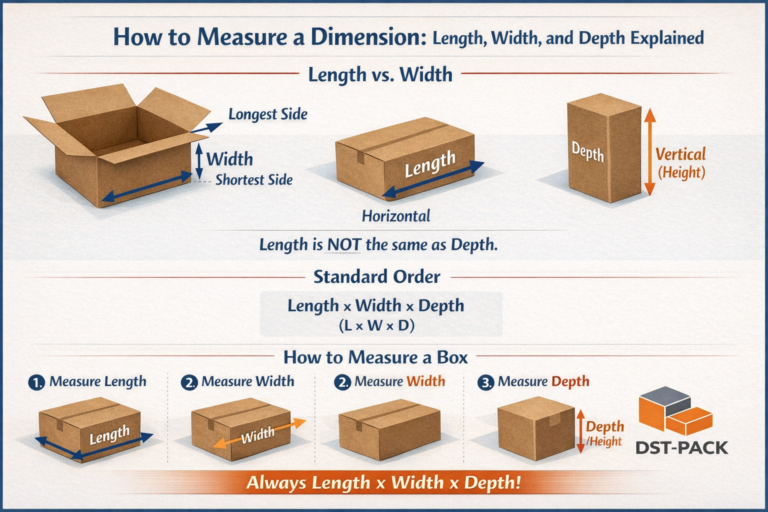
Length and width describe the horizontal sides of a box or product.
- Length is usually the longest side.
- Width is the shorter side.
For example, if you look at a rectangular box from the top, the longer side is the length, and the shorter side is the width. These measurements help manufacturers produce the right size and fit your product perfectly.
Is Length Same as Depth?
A common question is: is length same as depth? The answer is no.
- Length measures the horizontal side of the base.
- Depth (or height) measures the vertical side, from top to bottom.
Mixing these up can cause boxes to be too tall, too shallow, or not fit your product. Always make sure you know which dimension refers to which side.
Standard Dimension Order
Most packaging uses this format:
Length × Width × Depth (L × W × D)
Some use Length × Width × Height (L × W × H). Depth and height usually mean the same thing—the vertical measurement—so it’s important to confirm with your supplier which term they use.
How to Measure a Box or Product
- Place the product or box on a flat surface.
- Measure the length: the longest horizontal side.
- Measure the width: the shorter horizontal side.
- Measure the depth/height: from the bottom to the top.
Always measure inside dimensions if the product needs to fit inside the box. For shipping, outside dimensions may be needed.