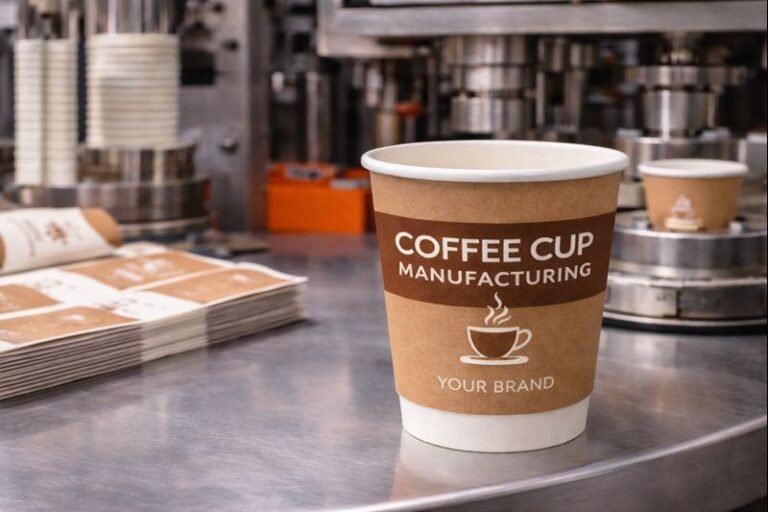
Coffee cups are one of the most widely used packaging products in the world, yet their manufacturing process is often underestimated. Whether used by cafés, coffee chains, offices, or takeaway services, a coffee cup must balance durability, insulation, safety, and brand presentation. Behind every well-made coffee cup is a carefully controlled manufacturing process that ensures performance under real-world conditions.
At DST-Pack, coffee cup manufacturing is approached as a combination of material engineering, food safety compliance, and brand-driven design.
Materials Used in Coffee Cup Manufacturing
The foundation of any coffee cup is the paperboard. Coffee cups are typically made from high-quality virgin paperboard designed for food contact. This paperboard must be strong enough to hold hot liquids while maintaining shape and structural integrity.
To prevent leakage, a thin internal lining is applied. Traditionally, this lining was polyethylene (PE), but modern manufacturing increasingly uses water-based or PLA coatings to improve recyclability. The choice of lining affects heat resistance, sealing quality, and environmental performance.
Cup sleeves, when included, are usually produced from corrugated or kraft paperboard. These sleeves add insulation and provide an additional branding surface.
Printing and Branding in Cup Production
Coffee cups are not just containers; they are moving advertisements. Printing is an essential step in coffee cup manufacturing and is handled before the cup is formed into its final shape.
Offset and flexographic printing are commonly used, depending on design complexity and order volume. Food-safe inks are mandatory, especially when printing near the cup rim. High-quality printing ensures that logos, patterns, and text remain sharp even when exposed to heat and moisture.
Brand consistency is especially important for cafés and chains that rely on visual recognition. Proper color management and quality control during printing ensure that every batch matches brand standards.
Cup Forming and Sealing Process
Once printed, the paperboard sheets are fed into cup-forming machines. These machines cut the paper into cup blanks, roll them into cylindrical shapes, and seal the side seam using heat or ultrasonic methods.
The bottom of the cup is inserted separately and sealed tightly to prevent leaks. This step is critical, as poor bottom sealing is one of the most common causes of cup failure.
Modern cup manufacturing equipment allows for precise control of seam strength and shape uniformity, ensuring that cups remain stable when filled with hot beverages.
Quality Control and Food Safety Standards
Coffee cups are food-contact packaging and must meet strict safety regulations. Manufacturing facilities operate under hygiene-controlled conditions, with regular inspections and material testing.
Quality control includes leak testing, seam strength checks, dimensional accuracy, and heat resistance verification. Cups are tested with hot liquids to ensure they maintain shape and do not soften or deform.
At DST-Pack, quality checks are integrated at every stage of production to ensure that the final product performs consistently in real café environments.
Custom Sizes and Functional Design
Coffee cup manufacturing is not limited to standard sizes. While popular volumes include 8 oz, 12 oz, and 16 oz, many brands require custom dimensions for specialty drinks or seasonal offerings.
Design considerations include rim thickness, grip comfort, and compatibility with standard lids. Even small adjustments in diameter or height can affect the user experience and storage efficiency.
Custom manufacturing allows brands to create cups that align perfectly with their beverage menu and operational workflow.
Sustainability in Coffee Cup Manufacturing
Sustainability is one of the most important topics in modern coffee cup production. Manufacturers are moving toward responsibly sourced paperboard, reduced plastic content, and coatings that support recycling or composting.
Lightweighting techniques are also used to reduce material consumption without compromising cup strength. This approach lowers transportation emissions and material waste.
Paper-based coffee cups, when designed correctly, remain one of the most efficient solutions for hot beverage packaging at scale.
Coffee Cup Manufacturing for Different Business Models
Coffee cups are produced for a wide range of customers, from independent cafés to international coffee chains. Manufacturing requirements vary depending on order volume, branding complexity, and logistical needs.
Small batches may focus on flexibility and customization, while large-scale production emphasizes consistency and cost efficiency. A reliable manufacturer must be able to support both models without compromising quality.
Manufacturing Coffee Cups with DST-Pack
At DST-Pack, coffee cup manufacturing is tailored to real usage conditions. We focus on producing cups that perform reliably during service, protect beverage quality, and represent the brand professionally.
From material selection and printing to forming and quality control, every stage is optimized to deliver coffee cups that meet modern expectations for performance, safety, and sustainability.